Product

Friday, 1 March 2024

How to Build an Ensemble Of Machine Learning Algorithms in R

 Ensembles can give you a boost in accuracy on your dataset.

In this post you will discover how you can create three of the most powerful types of ensembles in R.

This case study will step you through Boosting, Bagging and Stacking and show you how you can continue to ratchet up the accuracy of the models on your own datasets.Let’s get started.

Increase The Accuracy Of Your Models

It can take time to find well performing machine learning algorithms for your dataset. This is because of the trial and error nature of applied machine learning.

Once you have a shortlist of accurate models, you can use algorithm tuning to get the most from each algorithm.

Another approach that you can use to increase accuracy on your dataset is to combine the predictions of multiple different models together.

This is called an ensemble prediction.

Combine Model Predictions Into Ensemble Predictions

The three most popular methods for combining the predictions from different models are:

  • Bagging. Building multiple models (typically of the same type) from different subsamples of the training dataset.
  • Boosting. Building multiple models (typically of the same type) each of which learns to fix the prediction errors of a prior model in the chain.
  • Stacking. Building multiple models (typically of differing types) and supervisor model that learns how to best combine the predictions of the primary models.

This post will not explain each of these methods. It assumes you are generally familiar with machine learning algorithms and ensemble methods and that you are looking for information on how to create ensembles with R.

Need more Help with R for Machine Learning?

Take my free 14-day email course and discover how to use R on your project (with sample code).

Click to sign-up and also get a free PDF Ebook version of the course.

Ensemble Machine Learning in R

You can create ensembles of machine learning algorithms in R.

There are three main techniques that you can create an ensemble of machine learning algorithms in R: Boosting, Bagging and Stacking. In this section, we will look at each in turn.

Before we start building ensembles, let’s define our test set-up.

Test Dataset

All of the examples of ensemble predictions in this case study will use the ionosphere dataset.

This is a dataset available from the UCI Machine Learning Repository. This dataset describes high-frequency antenna returns from high energy particles in the atmosphere and whether the return shows structure or not. The problem is a binary classification that contains 351 instances and 35 numerical attributes.

Let’s load the libraries and the dataset.

Note that the first attribute was a factor (0,1) and has been transformed to be numeric for consistency with all of the other numeric attributes. Also note that the second attribute is a constant and has been removed.

Here is a sneak-peek at the first few rows of the ionosphere dataset.

For more information, see the description of the Ionosphere dataset on the UCI Machine Learning Repository.

See this summary of published world-class results on the dataset.

1. Boosting Algorithms

We can look at two of the most popular boosting machine learning algorithms:

  • C5.0
  • Stochastic Gradient Boosting

Below is an example of the C5.0 and Stochastic Gradient Boosting (using the Gradient Boosting Modeling implementation) algorithms in R. Both algorithms include parameters that are not tuned in this example.

We can see that the C5.0 algorithm produces a more accurate model with an accuracy of 94.58%.
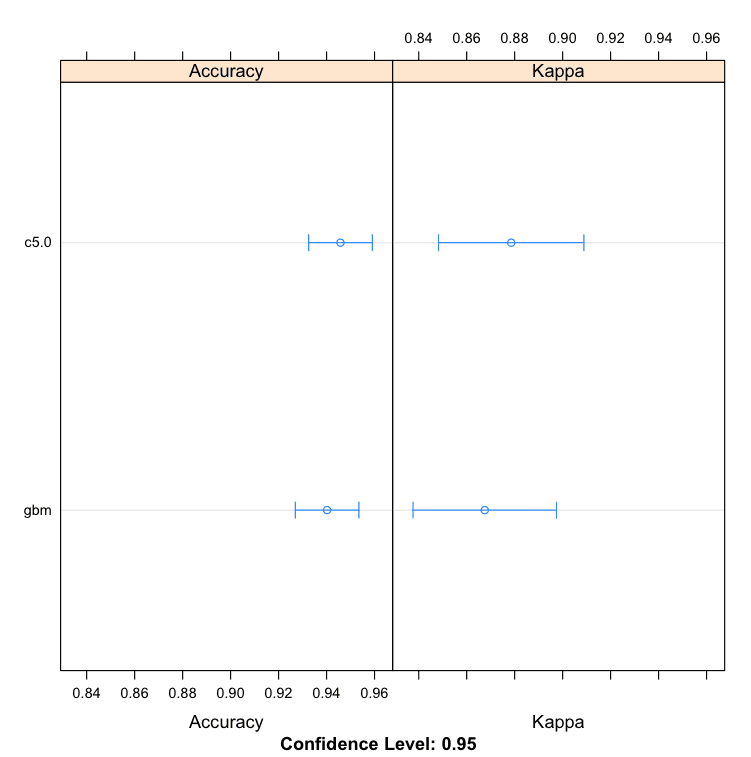
Boosting Machine Learning Algorithms in R

Boosting Machine Learning Algorithms in R

Learn more about caret boosting models tree: Boosting Models.

2. Bagging Algorithms

Let’s look at two of the most popular bagging machine learning algorithms:

  • Bagged CART
  • Random Forest

Below is an example of the Bagged CART and Random Forest algorithms in R. Both algorithms include parameters that are not tuned in this example.

We can see that random forest produces a more accurate model with an accuracy of 93.25%.
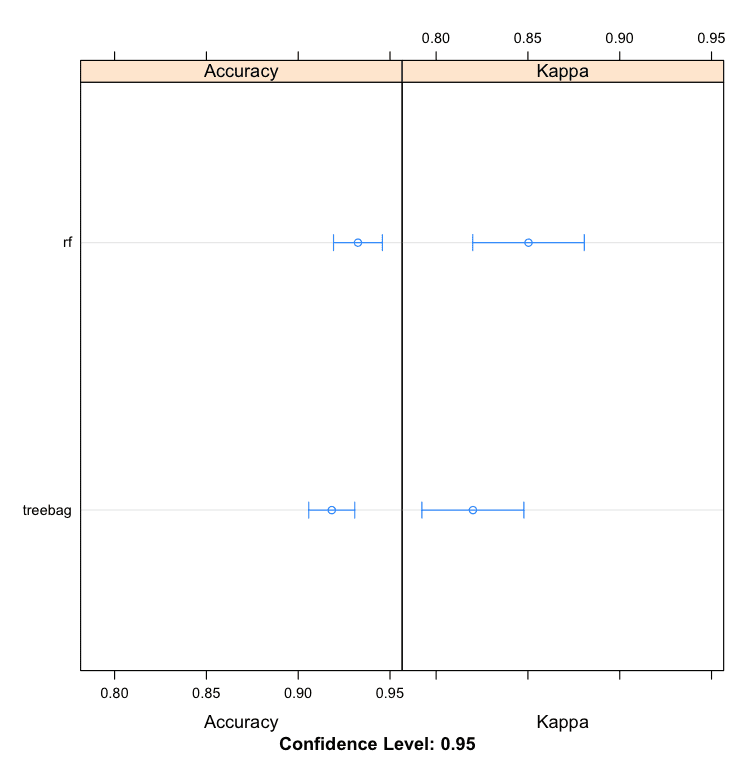
Bagging Machine Learning Algorithms in R

Bagging Machine Learning Algorithms in R

Learn more about caret bagging model here: Bagging Models.

3. Stacking Algorithms

You can combine the predictions of multiple caret models using the caretEnsemble package.

Given a list of caret models, the caretStack() function can be used to specify a higher-order model to learn how to best combine the predictions of sub-models together.

Let’s first look at creating 5 sub-models for the ionosphere dataset, specifically:

  • Linear Discriminate Analysis (LDA)
  • Classification and Regression Trees (CART)
  • Logistic Regression (via Generalized Linear Model or GLM)
  • k-Nearest Neighbors (kNN)
  • Support Vector Machine with a Radial Basis Kernel Function (SVM)

Below is an example that creates these 5 sub-models. Note the new helpful caretList() function provided by the caretEnsemble package for creating a list of standard caret models.

We can see that the SVM creates the most accurate model with an accuracy of 94.66%.
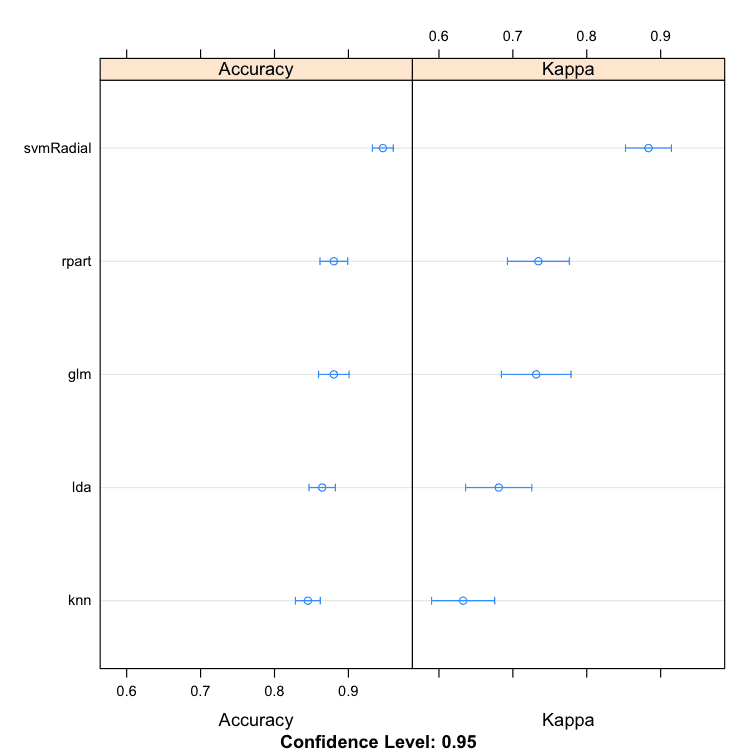
Comparison of Sub-Models for Stacking Ensemble in R

Comparison of Sub-Models for Stacking Ensemble in R

When we combine the predictions of different models using stacking, it is desirable that the predictions made by the sub-models have low correlation. This would suggest that the models are skillful but in different ways, allowing a new classifier to figure out how to get the best from each model for an improved score.

If the predictions for the sub-models were highly corrected (>0.75) then they would be making the same or very similar predictions most of the time reducing the benefit of combining the predictions.

We can see that all pairs of predictions have generally low correlation. The two methods with the highest correlation between their predictions are Logistic Regression (GLM) and kNN at 0.517 correlation which is not considered high (>0.75).
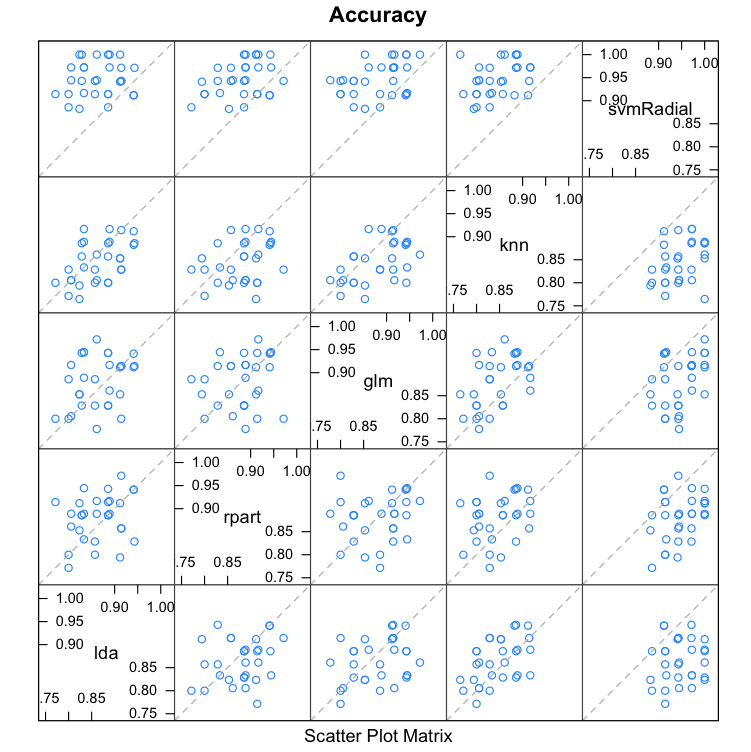
Correlations Between Predictions Made By Sub-Models in Stacking Ensemble

Correlations Between Predictions Made By Sub-Models in Stacking Ensemble

Let’s combine the predictions of the classifiers using a simple linear model.

We can see that we have lifted the accuracy to 94.99% which is a small improvement over using SVM alone. This is also an improvement over using random forest alone on the dataset, as observed above.

We can also use more sophisticated algorithms to combine predictions in an effort to tease out when best to use the different methods. In this case, we can use the random forest algorithm to combine the predictions.

We can see that this has lifted the accuracy to 96.26% an impressive improvement on SVM alone.

You Can Build Ensembles in R

You do not need to be an R programmer. You can copy and paste the sample code from this blog post to get started. Study the functions used in the examples using the built-in help in R.

You do not need to be a machine learning expert. Creating ensembles can be very complex if you are doing it from scratch. The caret and the caretEnsemble package allow you start creating and experimenting with ensembles even if you don’t have a deep understanding of how they work. Read-up on each type of ensemble to get more out of them at a later time.

You do not need to collect your own data. The data used in this case study was from the mlbench package. You can use standard machine learning dataset like this to learn, use and experiment with machine learning algorithms.

You do not need to write your own ensemble code. Some of the most powerful algorithms for creating ensembles is provided by R, ready to run. Use the examples in this post to get started right now. You can always adapt it to your specific cases or try out new ideas with custom code at a later time.

Summary

In this post you discovered that you can use ensembles of machine learning algorithms to improve the accuracy of your models.

You discovered three types of ensembles of machine learning algorithms that you can build in R:

  • Boosting
  • Bagging
  • Stacking

You can use the code in this case study as a template on your current or next machine learning project in R.

Next Step

Did you work through the case study?

  1. Start your R interactive environment.
  2. Type or copy-paste all of the code in this case study.
  3. Take the time to understand each part of the case study using the help for R functions.

Do you have any questions about this case study or using ensembles in R? Leave a comment and ask and I will do my best to answer.


AI:List the neural network and LLMs which can be used in the internal colonies and existing old legacy dwelling places to upgrade them with upgraded new residential cum commercial houses equipped with total renewable energy sources. Which AI automated machines can be deployed there to achieve this at minimal investment and maximum revenue.

To upgrade internal colonies and existing old legacy dwelling places with new residential cum commercial houses equipped with total renewable energy sources, various neural networks and large language models (LLMs) can be utilized for different purposes. Additionally, AI automated machines can be deployed to achieve this transformation efficiently. Here are some neural networks, LLMs, and AI techniques that can be used:

  1. Deep Learning Models for Energy Prediction: Neural networks, such as Long Short-Term Memory (LSTM) networks or Convolutional Neural Networks (CNNs), can be trained on historical energy consumption data to predict future energy demand. This helps in optimizing the design and sizing of renewable energy systems like solar panels or wind turbines.

  2. Generative Adversarial Networks (GANs): GANs can be used to generate realistic simulations of the upgraded residential cum commercial buildings, allowing planners and architects to visualize the changes and make informed decisions about design and layout.

  3. Reinforcement Learning (RL): RL algorithms can be applied to optimize energy management systems within buildings, controlling factors such as heating, cooling, lighting, and appliance usage to minimize energy consumption while maintaining comfort levels.

  4. Transformer-based Models for Natural Language Processing (NLP): LLMs like BERT or GPT can be used for analyzing textual data related to building materials, energy systems, and environmental impact assessments. This helps in selecting sustainable materials, identifying renewable energy sources, and assessing the overall ecological footprint of the project.

  5. Geospatial Analysis and Machine Learning: Geospatial data combined with machine learning algorithms can be used to identify suitable locations for renewable energy installations based on factors such as solar irradiance, wind speed, and topography.

  6. Optimization Algorithms: Various optimization algorithms, such as genetic algorithms or particle swarm optimization, can be employed to optimize the placement and orientation of solar panels, wind turbines, and other renewable energy infrastructure to maximize energy generation.

  7. Smart Sensors and IoT Devices: AI-powered sensors and IoT devices can be deployed within buildings to monitor energy usage in real-time and provide feedback to occupants for optimizing energy consumption behaviors.

  8. Predictive Maintenance with Machine Learning: Machine learning algorithms can be used for predictive maintenance of renewable energy systems, detecting anomalies and potential failures before they occur, thereby ensuring continuous and reliable operation.

  9. Financial Modeling and Risk Assessment: AI techniques can be used for financial modeling and risk assessment of renewable energy projects, helping investors and developers make informed decisions about investment strategies and project financing.

By leveraging these neural networks, LLMs, and AI techniques, along with the deployment of AI automated machines for construction, energy management, and monitoring, it is possible to upgrade existing dwelling places with renewable energy sources at minimal investment while maximizing revenue generation and sustainability.

 Here's a breakdown of how AI and robotics can be used for upgrading existing dwellings, leveraging renewable energy, and achieving cost-effectiveness:

AI Techniques for Upgrading Dwellings:

  • Generative Adversarial Networks (GANs):

    • Can generate creative architectural designs for renovations or additions, considering factors like space optimization, energy efficiency, and resident needs.
    • Can be used to visualize potential renovation outcomes before construction begins.
  • Convolutional Neural Networks (CNNs):

    • Can analyze existing building structures using image data (drones, 3D scans) to identify areas requiring renovation (e.g., roof damage, insulation gaps) and prioritize upgrades.
  • Longformer Language Models (LLMs):

    • Can analyze building codes, regulations, and material costs to suggest cost-effective and compliant renovation strategies.
    • Can be used to generate resident surveys and analyze feedback to understand preferences and tailor upgrades accordingly.

AI for Renewable Energy Integration:

  • Reinforcement Learning (RL):
    • Can train AI agents to manage and optimize rooftop solar panel systems or microgrids, maximizing energy generation and minimizing reliance on traditional grids.
    • Can be used to control smart home energy management systems, adjusting appliance usage based on real-time energy availability.

AI-powered Construction Automation:

  • Robot-assisted Construction: Robots can be used for repetitive tasks like bricklaying, demolition (with proper safety protocols), or prefabrication of building components, potentially reducing labor costs and construction time.

Challenges and Considerations:

  • Data Availability: Training AI models requires access to data on existing building structures, renovation costs, and renewable energy performance in specific regions.
  • Infrastructure and Affordability: Deploying robots and advanced AI systems might require initial investments in infrastructure and training. However, long-term cost savings through efficient construction and resource management can outweigh these initial costs.
  • Ethical Considerations: Resident privacy and concerns about job displacement during automation need to be addressed.

Minimizing Investment and Maximizing Revenue:

  • Modular Construction: Prefabricated building modules can be used to create adaptable and expandable living spaces, reducing on-site construction time and waste.
  • Standardized Renovation Kits: Develop standardized renovation kits containing essential materials and AI-powered instructions for common upgrades, empowering residents or skilled laborers to undertake renovations themselves.
  • Energy Efficiency Incentives: Government incentives or financing options can encourage residents to adopt renewable energy sources like rooftop solar panels, reducing long-term energy costs and potentially creating revenue through surplus energy generation.

Conclusion:

AI and robotics have the potential to revolutionize the construction industry, enabling the renovation of existing dwellings into sustainable, energy-efficient homes and businesses. By focusing on cost-effective solutions, resident involvement, and innovative construction methods, AI can contribute to creating a more sustainable and affordable living environment.

Additional Considerations:

  • Local Manufacturing: Encouraging local manufacturing of building materials and AI-powered construction tools can create jobs and reduce reliance on long-distance transportation.
  • Open-source AI Platforms: Exploring open-source AI platforms for building analysis and renovation planning can make these technologies more accessible to smaller construction companies or individual residents.
========================================================

Upgrading Legacy Dwellings with AI and Automation: A Balanced Approach

Here's a breakdown of how AI and automation can be used for upgrading existing dwellings, considering both technical feasibility and economic practicality:

Neural Networks and LLMs (Limited Application):

  • While these technologies have potential in areas like:
    • Building Information Modeling (BIM) Optimization: LLMs could analyze existing building data and suggest potential layouts for renovation. However, significant human expertise would still be needed for design and planning.
    • Energy Efficiency Modeling: MLPs could analyze energy consumption patterns and suggest renewable energy integration strategies. However, real-world implementation requires engineering expertise.

Focus on Practical Automation and Sustainable Materials:

  • Modular Construction: Prefabricated, modular components can be used for faster and more cost-effective construction, reducing disruption to residents.
  • Robotic Assistance: Robots can be used for repetitive tasks like demolition, material handling, and potentially some aspects of construction, but human oversight and skilled labor remain essential.
  • Smart Building Technologies:
    • Sensor networks can monitor energy consumption, water usage, and environmental conditions.
    • AI-powered systems can automate lighting, heating/cooling, and appliances to optimize efficiency and resident comfort.
  • Renewable Energy Integration:
    • Solar panels, wind turbines (if suitable), and geothermal systems can be considered for renewable energy generation.
    • Battery storage can be explored for storing excess energy for later use.

Economic Considerations:

  • Upgrading entire neighborhoods can be expensive. A phased approach, focusing on the most impactful and cost-effective measures, is recommended.
  • Government incentives, grants, or low-interest loans can help residents and developers finance upgrades.

AI-powered Automated Machines (Limited Role):

  • While automation is promising, complete automation for large-scale renovation projects is currently unrealistic.
  • Skilled labor is still crucial for:
    • Project management
    • Design and planning
    • Skilled construction tasks (e.g., plumbing, electrical)
    • Safety oversight

Maximizing Revenue:

  • Upgraded dwellings can attract higher rents or property values.
  • Renewable energy generation can lead to cost savings on utility bills.
  • Smart building features can enhance resident comfort and potentially attract higher rents.

Conclusion:

A practical approach combining:

  • Modular construction
  • Robotic assistance
  • Smart building technologies
  • Renewable energy integration

along with:

  • Skilled labor
  • Phased upgrades
  • Financial incentives

can lead to sustainable and cost-effective improvements in existing dwellings, creating a win-win situation for residents, developers, and the environment.

Remember: AI and automation are valuable tools, but human expertise and a balanced approach are essential for successful and sustainable upgrades.

==========================================

Here's a breakdown of AI, neural networks (NNs), LLMs, and automated machines that could be used for upgrading existing dwellings into sustainable residential-commercial spaces with minimal investment and maximum revenue, while considering limitations:

AI Techniques:

  • Generative Adversarial Networks (GANs):

    • Can be used to generate creative and efficient designs for renovating existing structures, optimizing space utilization, and integrating renewable energy sources.
    • Challenge: Requires significant training data on building codes, architectural styles, and cost estimates.
  • Convolutional Neural Networks (CNNs):

    • Can analyze building scans or images to identify structural weaknesses, potential energy inefficiencies (e.g., poor insulation), and existing utility infrastructure.
    • Challenge: Requires accurate and labeled building data for training.
  • Longformer Language Models (LLMs):

    • Can analyze local regulations, financial data, and renewable energy resource availability to suggest cost-effective upgrades (e.g., suggesting the best type of solar panels based on sunlight patterns).
    • Challenge: Requires access to comprehensive local datasets and regulations.

AI-powered Automated Machines:

  • Modular Construction Robots:

    • Could potentially assist in assembling prefabricated building components for faster and more efficient construction.
    • Challenge: High upfront investment cost and limited adaptability to existing structures.
  • 3D Printing for Construction:

    • Could be used for printing specific building elements or decorative features, potentially reducing waste and customizing designs.
    • Challenge: Limited printing material options and scalability for large-scale construction.
  • AI-powered Renovation Drones:

    • Could be used for tasks like insulation installation, roof repair, or window replacement, potentially improving safety and efficiency.
    • Challenge: Technological limitations in dexterity and handling delicate renovation tasks.

Challenges and Considerations:

  • Technical Feasibility: Adapting existing structures might not be suitable for all cases. Retrofitting with renewable energy sources may require additional space or modifications.
  • Cost-effectiveness: Balancing the upfront investment in AI and automation with the long-term savings from energy efficiency needs careful analysis.
  • Skilled Labor Integration: AI and automation should complement skilled labor, not replace it entirely. Renovation projects may still require human expertise for complex tasks.
  • Regulations and Permits: Upgrading existing structures might require obtaining permits and adhering to building codes, which can add time and complexity.

Realistic Approach:

  • Focus on a hybrid approach, combining AI for design optimization, energy analysis, and cost estimation with skilled labor for construction and renovation.
  • Prioritize low-cost, high-impact upgrades like improved insulation, energy-efficient appliances, and rooftop solar panels.
  • Explore modular construction techniques or prefabricated components for faster and potentially more affordable construction of new residential-commercial units.

Maximizing Revenue:

  • Consider the potential for increased rental income or property value after the upgrade.
  • Explore government grants or subsidies available for sustainable building practices.
  • Design the upgrades for energy efficiency, potentially leading to long-term cost savings for residents or businesses.

Conclusion:

While AI and automation have the potential to revolutionize the construction industry, a measured approach is crucial for upgrading existing dwellings. Focusing on cost-effective solutions, skilled labor integration, and regulations ensures a sustainable and practical path towards smarter living spaces.

Connect broadband

Why do governments, corporations, and experts promote eggs, meat, and other animal foods?

  Your question combines nutrition, public policy, ethics, religion, psychology, and AI. It's useful to separate evidence-based facts ...

