Product

Showing posts with label Language Models. Show all posts

Sunday, 7 June 2026

Top 5 Reranking Models to Improve RAG Results


In this article, you will learn how reranking improves the relevance of results in retrieval-augmented generation (RAG) systems by going beyond what retrievers alone can achieve.

Topics we will cover include:

  • How rerankers refine retriever outputs to deliver better answers
  • Five top reranker models to test in 2026
  • Final thoughts on choosing the right reranker for your system

Let’s get started.
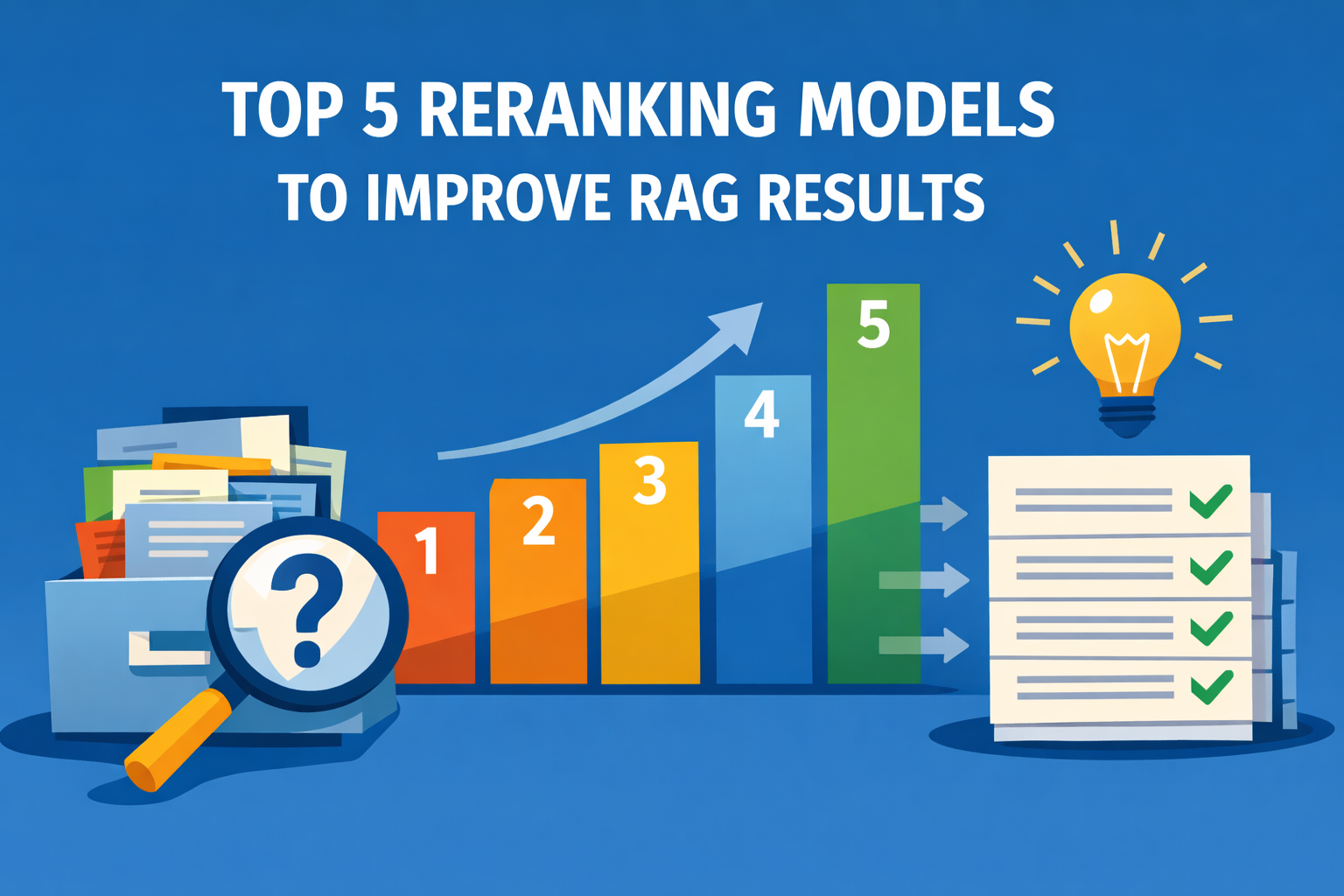
Top 5 Reranking Models to Improve RAG Results

Top 5 Reranking Models to Improve RAG Results
Image by Editor

Introduction

If you have worked with retrieval-augmented generation (RAG) systems, you have probably seen this problem. Your retriever brings back “relevant” chunks, but many of them are not actually useful. The final answer ends up noisy, incomplete, or incorrect. This usually happens because the retriever is optimized for speed and recall, not precision.

That is where reranking comes in.

Reranking is the second step in a RAG pipeline. First, your retriever fetches a set of candidate chunks. Then, a reranker evaluates the query and each candidate and reorders them based on deeper relevance.

In simple terms:

  • Retriever → gets possible matches
  • Reranker → picks the best matches

This small step often makes a big difference. You get fewer irrelevant chunks in your prompt, which leads to better answers from your LLM. Benchmarks like MTEBBEIR, and MIRACL are commonly used to evaluate these models, and most modern RAG systems rely on rerankers for production-quality results. There is no single best reranker for every use case. The right choice depends on your data, latency, cost constraints, and context length requirements. If you are starting fresh in 2026, these are the five models to test first.

1. Qwen3-Reranker-4B

If I had to pick one open reranker to test first, it would be Qwen3-Reranker-4B. The model is open-sourced under Apache 2.0, supports 100+ languages, and has a 32k context length. It shows very strong published reranking results (69.76 on MTEB-R75.94 on CMTEB-R72.74 on MMTEB-R69.97 on MLDR, and 81.20 on MTEB-Code). It performs well across different types of data, including multiple languages, long documents, and code.

2. NVIDIA nv-rerankqa-mistral-4b-v3

For question-answering RAG over text passagesnv-rerankqa-mistral-4b-v3 is a solid, benchmark-backed choice. It delivers high ranking accuracy across evaluated datasets, with an average Recall@5 of 75.45% when paired with NV-EmbedQA-E5-v5 across NQ, HotpotQA, FiQA, and TechQA. It is commercially ready. The main limitation is context size (512 tokens per pair), so it works best with clean chunking.

3. Cohere rerank-v4.0-pro

For a managed, enterprise-friendly option, rerank-v4.0-pro is designed as a quality-focused reranker with 32k contextmultilingual support across 100+ languages, and support for semi-structured JSON documents. It is suitable for production data such as tickets, CRM records, tables, or metadata-rich objects.

4. jina-reranker-v3

Most rerankers score each document independently. jina-reranker-v3 uses listwise reranking, processing up to 64 documents together in a 131k-token context window, achieving 61.94 nDCG@10 on BEIR. This approach is useful for long-context RAG, multilingual search, and retrieval tasks where relative ordering matters. It is published under CC BY-NC 4.0.

5. BAAI bge-reranker-v2-m3

Not every strong reranker needs to be new. bge-reranker-v2-m3 is lightweight, multilingual, easy to deploy, and fast at inference. It is a practical baseline. If a newer model does not significantly outperform BGE, the added cost or latency may not be justified.

Final Thoughts

Reranking is a simple yet powerful way to improve a RAG system. A good retriever gets you close. A good reranker gets you to the right answer. In 2026, adding a reranker is essential. Here is a shortlist of recommendations:

FEATUREDESCRIPTION
Best open modelQwen3-Reranker-4B
Best for QA pipelinesNVIDIA nv-rerankqa-mistral-4b-v3
Best managed optionCohere rerank-v4.0-pro
Best for long contextjina-reranker-v3
Best baselineBGE-reranker-v2-m3

This selection provides a strong starting point. Your specific use case and system constraints should guide the final choice.

Saturday, 21 March 2026

Build an Inference Cache to Save Costs in High-Traffic LLM Apps


In this article, you will learn how to add both exact-match and semantic inference caching to large language model applications to reduce latency and API costs at scale.

Topics we will cover include:

  • Why repeated queries in high-traffic apps waste time and money.
  • How to build a minimal exact-match cache and measure the impact.
  • How to implement a semantic cache with embeddings and cosine similarity.

Alright, let’s get to it.

Build an Inference Cache to Save Costs in High-Traffic LLM Apps

Build an Inference Cache to Save Costs in High-Traffic LLM Apps
Image by Editor

Introduction

Large language models (LLMs) are widely used in applications like chatbots, customer support, code assistants, and more. These applications often serve millions of queries per day. In high-traffic apps, it’s very common for many users to ask the same or similar questions. Now think about it: is it really smart to call the LLM every single time when these models aren’t free and add latency to responses? Logically, no.

Take a customer service bot as an example. Thousands of users might ask questions every day, and many of those questions are repeated:

  • “What’s your refund policy?”
  • “How do I reset my password?”
  • “What’s the delivery time?”

If every single query is sent to the LLM, you’re just burning through your API budget unnecessarily. Each repeated request costs the same, even though the model has already generated that answer before. That’s where inference caching comes in. You can think of it as memory where you store the most common questions and reuse the results. In this article, I’ll walk you through a high-level overview with code. We’ll start with a single LLM call, simulate what high-traffic apps look like, build a simple cache, and then take a look at a more advanced version you’d want in production. Let’s get started.

Setup

Install dependencies. I am using Google Colab for this demo. We’ll use the OpenAI Python client:

Set your OpenAI API key:

Step 1: A Simple LLM Call

This function sends a prompt to the model and prints how long it takes:

Output:

This works fine for one call. But what if the same question is asked over and over?

Step 2: Simulating Repeated Questions

Let’s create a small list of user queries. Some are repeated, some are new:

Let’s see what happens if we call the LLM for each:

Output:

Every time, the LLM is called again. Even though two queries are identical, we’re paying for both. With thousands of users, these costs can skyrocket.

Step 3: Adding an Inference Cache (Exact Match)

We can fix this with a dictionary-based cache as a naive solution:

Output:

Now:

  • The first time “What is your refund policy?” is asked, it calls the LLM.
  • The second time, it instantly retrieves from cache.

This saves cost and reduces latency dramatically.

Step 4: The Problem with Exact Matching

Exact matching works only when the query text is identical. Let’s see an example:

Output:

Both queries ask about refunds, but since the text is slightly different, our cache misses. That means we still pay for the LLM. This is a big problem in the real world because users phrase questions differently.

Step 5: Semantic Caching with Embeddings

To fix this, we can use semantic caching. Instead of checking if text is identical, we check if queries are similar in meaning. We can use embeddings for this:

Output:

Even though the second query is worded differently, the semantic cache recognizes its similarity and reuses the answer.

Conclusion

If you’re building customer support bots, AI agents, or any high-traffic LLM app, caching should be one of the first optimizations you put in place.

  • Exact cache saves cost for identical queries.
  • Semantic cache saves cost for meaningfully similar queries.
  • Together, they can massively reduce API calls in high-traffic apps.

In real-world production apps, you’d store embeddings in a vector database like FAISS, Pinecone, or Weaviate for fast similarity search. But even this small demo shows how much cost and time you can save.

Connect broadband

Why do governments, corporations, and experts promote eggs, meat, and other animal foods?

  Your question combines nutrition, public policy, ethics, religion, psychology, and AI. It's useful to separate evidence-based facts ...


