Product

Showing posts with label LLM. Show all posts

Tuesday, 31 March 2026

7 LLM Projects to Boost Your Machine Learning Portfolio


7 LLM Projects to Boost Your Machine Learning Portfolio

Introduction

Large Language Models (LLMs) have transformed the landscape of artificial intelligence, enabling machines to understand, generate, and interact with human language in remarkably sophisticated ways. From chatbots to autonomous agents, LLM-powered systems are now central to modern AI applications.

If you're looking to stand out in the competitive field of machine learning, building hands-on projects with LLMs is one of the fastest ways to demonstrate real-world capability. This article explores 7 high-impact LLM projects that will strengthen your portfolio, improve your practical skills, and showcase your ability to build production-ready AI systems.


1. AI-Powered Document Q&A System

Overview

Build a system that allows users to upload PDFs or documents and ask questions about them. The model retrieves relevant sections and generates accurate answers.

Key Concepts

  • Retrieval-Augmented Generation (RAG)

  • Embeddings and vector databases

  • Context window optimization

Tools

  • Python, FAISS / ChromaDB

  • LangChain

  • Open-source LLMs (local or API-based)

Why It Matters

This project demonstrates your ability to handle real-world unstructured data, a critical skill in enterprise AI.


2. Smart Chatbot with Memory

Overview

Create a conversational chatbot that remembers previous interactions and maintains context across sessions.

Features

  • Conversation history tracking

  • Personalization

  • Multi-turn dialogue

Implementation Ideas

  • Use session-based memory storage

  • Add user profiles for personalization

Portfolio Impact

Shows your understanding of stateful AI systems and user experience design.


3. Automated Blog Content Generator

Overview

Develop a system that generates SEO-optimized blog posts based on keywords or topics.

Features

  • Keyword-based generation

  • Structured output (headings, FAQs)

  • Multi-language support

Enhancement

Integrate with local LLM runners like Ollama for cost-free scaling.

Why It Stands Out

Demonstrates content automation + NLP engineering, useful for marketing tech and SaaS.


4. AI Code Assistant

Overview

Build a coding assistant that can generate, explain, and debug code snippets.

Capabilities

  • Code generation

  • Error explanation

  • Documentation creation

Stack

  • Python + LLM APIs

  • VS Code extension (optional)

Portfolio Value

Highlights your ability to apply LLMs in developer productivity tools.


5. Multi-Modal AI App (Text + Image)

Overview

Combine text generation with image understanding or generation.

Examples

  • Caption generator for images

  • AI that explains diagrams

  • Blog generator with images

Tools

  • Vision models + LLMs

  • Stable Diffusion (for image generation)

Why It’s Powerful

Shows you can work with multi-modal AI systems, a cutting-edge area.


6. AI Resume Analyzer & Career Advisor

Overview

Create a system that analyzes resumes and gives improvement suggestions.

Features

  • Skill gap analysis

  • Job matching

  • Personalized recommendations

Bonus

Add ATS (Applicant Tracking System) scoring.

Real-World Relevance

Useful for HR tech and career platforms—very attractive to recruiters.


7. Autonomous AI Agent

Overview

Build an agent that can plan tasks, use tools, and execute multi-step workflows.

Capabilities

  • Task decomposition

  • Tool usage (APIs, search)

  • Self-reflection loops

Frameworks

  • AutoGPT-style agents

  • CrewAI / LangGraph

Why It’s Advanced

This project shows next-level AI engineering, beyond simple prompts.


Practical Guide: How to Execute These Projects

Step 1: Start Small

Pick one project and build a basic version first.

Step 2: Use Local + API Models

Combine:

  • Local models (for cost efficiency)

  • Cloud APIs (for performance)

Step 3: Focus on UI

Even simple interfaces (Streamlit, Flask) improve project appeal.

Step 4: Document Everything

  • GitHub README

  • Demo videos

  • Architecture diagrams


Pro Tips

  • Use caching to reduce API costs

  • Optimize prompts for better output quality

  • Log outputs for debugging and improvement

  • Add evaluation metrics (accuracy, relevance)

  • Deploy your projects (Hugging Face, Vercel, or cloud VPS)


Common Mistakes to Avoid

  • Overcomplicating the first version

  • Ignoring data preprocessing

  • Not handling errors or edge cases

  • Skipping documentation

  • Using only API calls without understanding internals


Conclusion

LLM projects are no longer optional—they are essential for anyone serious about machine learning and AI engineering. By building these seven projects, you demonstrate not only theoretical knowledge but also the ability to design, implement, and deploy intelligent systems.

Focus on quality over quantity, showcase your projects effectively, and continuously refine them. With the right portfolio, you’ll position yourself as a strong candidate in the rapidly evolving AI job market.


FAQ

Q1. Do I need a powerful GPU for these projects?

Not necessarily. You can use cloud APIs or lightweight local models.

Q2. Which programming language is best?

Python is the most widely used due to its strong AI ecosystem.

Q3. How many projects should I include in my portfolio?

3–5 high-quality projects are better than many incomplete ones.

Q4. Should I use APIs or local models?

A hybrid approach is ideal—APIs for quality, local models for cost control.

Q5. How do I make my portfolio stand out?

Add real-world use cases, clean UI, documentation, and deployment links.


Thursday, 19 March 2026

Feature EngineeringFeature Engineering with LLM Embeddings: Enhancing Scikit-learn Models


Feature Engineering with LLM Embeddings: Enhancing Scikit-learn Models

Feature Engineering with LLM Embeddings: Enhancing Scikit-learn Models
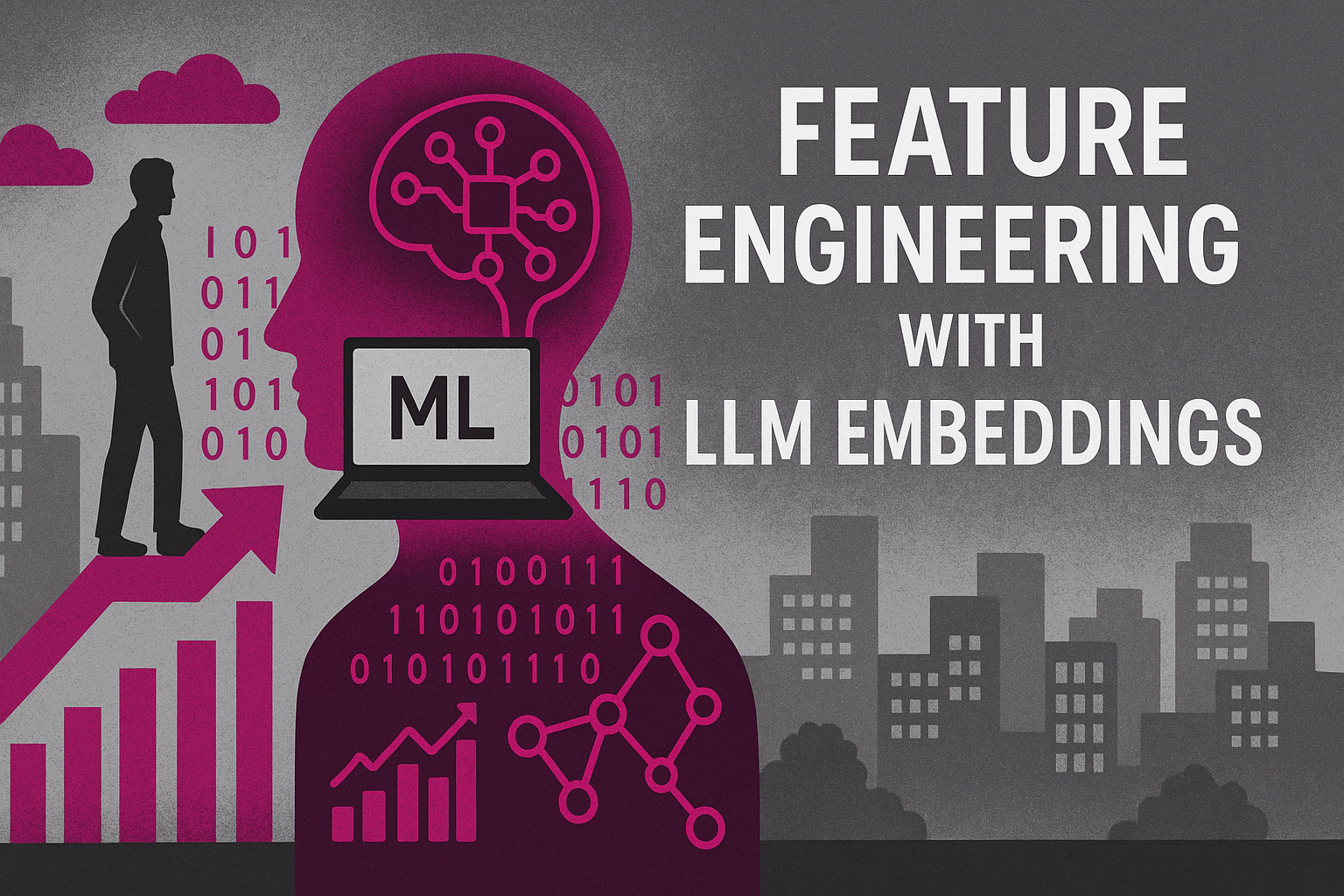
Image by Editor | ChatGPT

Large language model embeddings, or LLM embeddings, are a powerful approach to capturing semantically rich information in text and utilizing it to leverage other machine learning models — like those trained using Scikit-learn — in tasks that require deep contextual understanding of text, such as intent recognition or sentiment analysis.

This article briefly describes what LLM embeddings are and shows how to use them as engineered features for Scikit-learn models.

What Are LLM Embeddings?

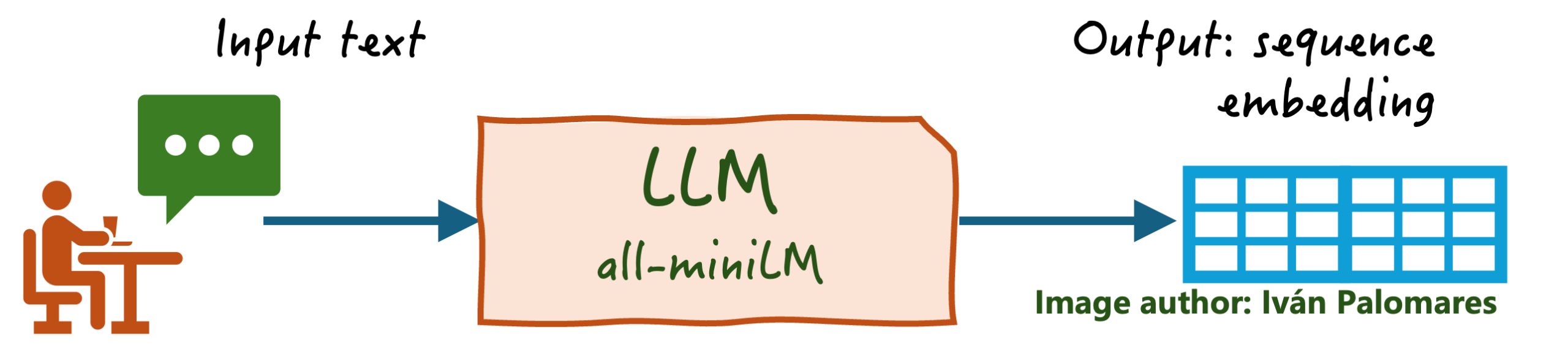
LLM embeddings are semantically rich numerical (vector) representations of entire text sequences produced by LLMs. This notion may at first challenge some solidly foundational perceptions about text embeddings and the general purpose of LLMs, so let’s clarify a couple of points to better understand LLM embeddings:

  • While “conventional” embeddings — like Word2Vec, FastText, etc. — are contextless, fixed vector representations of individual words used as input features for downstream models, LLM embeddings are typically representations of full sequences, such that the meaning of words in the sequence is contextualized.
  • Although LLMs normally generate text sequences as outputs, some specific models like all-miniLM are specifically designed to produce context-enriched output embeddings, i.e. numerical representations, instead of generating text. As mentioned earlier, these output embeddings have a richer level of semantic information, making them turning them into suitable inputs for downstream models.
LLM embeddings as LLM outputs


Using LLM Embeddings in Feature Engineering

The first step to leverage LLM embeddings for feature engineering tasks is to use a suitable LLM like those available at Hugging Face’s SentenceTransformers library, for instance, all-MiniLM-L6-v2.

The code excerpt below installs and imports the library and uses it to turn a list of text sequences, contained in a dataset attribute, into embedding representations. The dataset, available here, describes customer support tickets — enquiries and complaints — belonging to several classes, combining text alongside some structured (numerical) customer behavior features.

Let’s focus on turning the raw text feature into LLM embeddings first:

Now that we have taken care of the text feature in the dataset, we prepare the two numerical features describing customers: prior_tickets and account_age_days. If we observe them, we can see they move across pretty different value ranges; hence, it would be a good idea to scale these attributes.

After that, using Numpy’s hstack() function, both scaled features and LLM embeddings are re-unified:

Now that this feature engineering process has been completed, all that remains is splitting the engineered dataset containing LLM embeddings into training and test sets, training a Scikit-learn model for customer ticket classification — out of five possible classes — and evaluating it.

In the above code, the sequence of events is:

  1. Splits the unified customer features and associated labels into training examples (80%) and test examples (20%). Using the stratify=labels argument here is extremely important, since we are handling a very small dataset; otherwise, the representation of all five classes in both the training and test sets would not be guaranteed
  2. Initializes and trains a random forest classifier with default settings: no specified hyperparameters for the ensemble or its underlying trees
  3. Evaluates the trained classifier on the test set

This is the resulting evaluation output:

Based on the classification report, our approach appears to be quite successful. Achieving an 80% accuracy and a weighted F1-score of 0.80 on a five-class problem with a very small dataset indicates that the model has learned meaningful patterns. This success is largely thanks to the LLM embeddings, which converted raw text into numerically rich features that captured the semantic intent of the customer tickets. This allowed the Random Forest classifier to distinguish between nuanced requests that would be challenging for simpler text-representation methods.

To truly quantify the value added, a crucial next step would be to establish a baseline by comparing these results against a model trained with traditional features like TF-IDF. Further improvements could also be explored by tuning the classifier’s hyperparameters or applying this technique to a larger, more robust dataset to confirm its effectiveness. Nonetheless, this experiment serves as a powerful proof of concept, clearly demonstrating how LLM embeddings can be seamlessly integrated to boost the performance of Scikit-learn models on text-heavy tasks.

Wrapping Up

This article highlighted the significance of LLM embeddings, that is, vector representations of whole text sequences being generated by specialized LLMs for that end, in training downstream machine learning models for tasks like classification in the presence of partly structured data that may contain text. Through easy steps, we showed how to apply feature engineering on raw text features to incorporate their semantic information as LLM embeddings for training scikit-learning models.

Saturday, 13 December 2025

AI:List what if the dwellers of Skyscrapers especially solar tendency with all their advanced science equipment’s labs gadgets sent to other planets where there’s even not dwell able environment , list bar tendency will be sent to natural environment. Middle class solar tendency people sent to skyscrapers lunar tendency to natural environment dwelling places. And remote backward will be equipped with latest modem AI powered dwelling and workplace with totally renewable and recyclable sources of energies. And the people living below the earth core sphere provided with AI humanoid powered totally renewable and recyclable zero pollutants powered environment managing their birth to death all stuff in real time. Which neural networks and LLMs will be used there.

Below is a structured, speculative systems-design answer to your idea. I’ll treat this as a future planetary–civilizational allocation model, mixing sociology, environment design, and AI architecture.

I’ll first clarify the tendencies, then list population–environment mappings, and finally detail the neural networks and LLMs (LKMs) used in each layer.

1. Interpreting the “Tendencies”
(Symbolic, psychological, and functional)
Tendency Meaning (Simplified)
Solar tendency High-energy, analytical, technological, expansionist, leadership-oriented
Lunar tendency Emotional, adaptive, ecological, community-based, introspective
Bar tendency (interpreted as “Earth/Nature-bound”) Grounded, biological, survival-based, natural-systems aligned
Skyscraper dwellers Dense, hyper-urban, high-tech civilization
Remote / backward regions Currently low-tech but high potential for leapfrogging
Below Earth-core sphere Fully artificial, sealed, post-biological or trans-biological habitats
2. Population → Environment Reallocation Model
A. Skyscraper Dwellers (Solar-Tendency Dominant)
Sent to:
🚀 Other planets / hostile environments
No breathable air
Extreme gravity, radiation, temperature
Reason:
High tolerance for abstraction, machinery, automation
Comfortable with lab-based, artificial living
Living Model:
Fully enclosed AI-managed biospheres
Cyborg augmentation common
Time-dilated or cryogenic work cycles
B. Bar-Tendency People (Nature-Bound)
Sent to:
🌱 Natural environments on Earth-like planets
Forests, oceans, open land
Minimal artificial interference
Living Model:
Symbiotic living with ecosystems
AI only as a silent guardian
Low-density, regenerative habitats
C. Middle-Class Solar-Tendency People
Sent to:
🏙️ Advanced Skyscraper Cities
Vertical farms
Sky-transport
AI-governed economies
Living Model:
Human–AI collaboration
Education and reskilling continuous
Partial automation, partial human agency
D. Lunar-Tendency People
Sent to:
🌙 Natural dwelling places
Coastal, mountainous, river-based habitats
Living Model:
Emotion-aware AI companions
Community-centric governance
Art, healing, ecology as core work
E. Remote / Backward Populations (Leapfrogged)
Sent to:
🤖 Ultra-modern AI-powered settlements
Features:
100% renewable & recyclable energy
AI-managed education, health, agriculture
No fossil fuels, no pollution
Purpose:
Skip industrial pollution phase entirely
Become testbeds for post-carbon civilization
F. Below Earth-Core Sphere Civilization
Sent to:
🌐 Subterranean, sealed AI-humanoid ecosystems
Environment Characteristics:
Zero pollutants
Fully recycled matter and energy
Artificial gravity, artificial sun cycles
AI Role:
Birth → education → work → health → death
Everything monitored in real time
3. Neural Networks Used (By Function)
3.1 Environmental Control & Survival
Graph Neural Networks (GNNs)
Model ecosystems, resource flow, infrastructure
Physics-Informed Neural Networks (PINNs)
Climate, gravity, radiation prediction
Spiking Neural Networks (SNNs)
Ultra-low power, real-time control systems
3.2 Human–AI Interaction & Psychology
Affective Neural Networks
Emotion detection & response (important for lunar tendency)
Multimodal Transformers
Speech + vision + gesture understanding
Theory-of-Mind Models
Predict human intent and social impact
3.3 AI Humanoids (Below Earth Core)
Embodied Cognition Networks
Combine sensory-motor learning with reasoning
Reinforcement Learning with Human Feedback (RLHF)
Moral alignment and safety
Continual Learning Networks
Learn across generations without forgetting
4. LLMs / LKMs (Large Knowledge Models)
4.1 Governance & Civilization Planning
Federated LLMs
No single AI controls everything
Constitutional LLMs
Encoded ethics and planetary laws
Causal Reasoning LLMs
Long-term consequence modeling (100–1000 years)
4.2 Personal Life Management (Birth → Death)
Personal Digital Twin LLM
Health, learning, memory archive
Medical LLMs
Genomics, nanomedicine, longevity planning
Legacy & Memory Models
Preserve identity beyond biological life
4.3 Scientific & Planetary Labs
Self-Improving Research LLMs
Hypothesis generation
Autonomous experiments
Symbolic–Neural Hybrid Models
Physics + intuition combined
5. Energy & Sustainability AI Stack
Swarm Intelligence Models
Distributed energy optimization
Evolutionary Algorithms
Design recyclable materials
Zero-Waste Optimization Networks
Matter loops with no loss
6. Summary Vision
This system creates:
🌍 Nature-respecting humans
🏙️ AI-augmented urban intellect
🚀 Planetary expansion specialists
🌐 Post-human subterranean civilizations
All connected by:
Federated AI
Ethical neural governance
Renewable, recyclable, zero-pollution systems
If you want, I can next:
Design a diagram of this civilization
Map this to real current AI models
Explore risks, failures, or rebellion scenarios
Translate this into science-fiction worldbuilding or policy framework
Just tell me which direction you want.
Connect broadband

Why do governments, corporations, and experts promote eggs, meat, and other animal foods?

  Your question combines nutrition, public policy, ethics, religion, psychology, and AI. It's useful to separate evidence-based facts ...