Product

Showing posts with label Analytics. Show all posts

Friday, 14 April 2023

Winning with AI

 Since the year 2000, 52% of the companies that make up the Fortune 500 have disappeared. They have been acquired, succumbed to performance atrophy, or declared bankruptcy. In this hyper-competitive marketplace, winners and losers are being declared every day. And while artificial intelligence (AI) can be the valve to these pressures, for many, drafting a playbook for actually winning with AI remains daunting.

Also, consider a recent IDC Cloud and AI Adoption Survey[1] in which more than 80% of respondents said they plan to move, or repatriate, data and workloads from public cloud environments to private clouds or on-premises locations over the next year, as the initial expectations of a single public cloud provider were not realized. These dynamics add to the confusion that every CEO, CIO, CTO, and CDO faces on a daily basis.

So, what precisely is dragging down projects and preventing companies from delivering measurable business value? I see three recurring patterns:

  • Companies have been accumulating data at an amazing pace for years, but are still challenged with how to store, manage, and control access. They need a new, modern approach;
  • The pressure to innovate is mounting. Companies create a chief data office or a data science center of excellence, but do not always have the right model for organizational success;
  • Small successes only scale when models are put into production and companies adapt their business processes, but unfortunately, this doesn’t occur very often. Scale requires platform thinking and technology.

Companies are at a critical juncture. They must be able to find and scale insights on demand if they want to climb the Ladder to AI.

Enter the Data Platform

This summer IBM launched an innovative approach and solution to this conundrum. Our new IBM Cloud Private for Data (ICP for Data) is a modern data platform designed to integrate data science, data engineering and application building into an environment that companies can use to uncover previously hidden insights from their data. Built on IBM Cloud Private, ICP for Data includes an enterprise meta-data catalog as the centerpiece along with services for data federation/virtualization, data warehousing, data integration, data science / machine learning and embedded dash-boarding.

Rob Thomas, General Manager, IBM Analytics.

It is designed to connect all data across an enterprise seamlessly, starting with enterprise data, and offers all its capabilities as data micro services. Consider it the highway system for the data revolution.

But enduring platforms require meaningful, consistent innovation and refinement, as well as an ecosystem. And that’s what we’ve been doing ever since our May 29 launch of ICP for Data. Since announcing, we’ve added functionality like data management support for MongoDB and EDS Postgres for the enterprise, as well as the integration of IBM Data Risk Manager for holistic views of all data.

And in July we released an edition targeted at medium-sized enterprises, delivering the same functionality at a lower price point.

Advancing AI

This week, we’re advancing the platform even further, announcing that ICP for Data is working with Red Hat to certify the platform to run on Red Hat OpenShift, the company’s open source container application platform. The move builds on news we made with Red Hat this summer to enable the easy integration of IBM’s extensive middleware and data management with OpenShift. Now with ICP for Data certified for OpenShift, clients will be able to run their cloud-native workloads across OpenShift’s vast landscape and stretching across on premises, public and private clouds.

Simultaneously, IBM partner and maker of the leading Hadoop distribution, HortonWorks is also certifying for OpenShift, opening an even wider opportunity for our clients to exploit the Kubernetes-based platform. The three of us made an announcement on the moves just days ago.

In addition, we are releasing a new edition of ICP for Data, called ICP for Data Experiences – a no cost trial version – that gives new clients an easy and intuitive introduction to the platform. Through the solution, developers and data engineers alike can move quickly through the steps it takes to do things like collect and prepare the right data for machine learning models, create predictive analytics models to understand future outcomes, and how to go about deploying and managing these models.

Another innovative feature we’re adding to ICP for Data today is a first-of-a-kind technology that is designed to enable people to write analytics queries that can access data anywhere across the enterprise, be it from servers, desktops, mobile devices, a car, etc., as if you were searching a single database. It’s like we’re giving people the ability to SQL the world. And because it’s on ICP for Data, this new feature can help you find the data you’re looking for whether it’s on premises, or on private or public clouds.

In a related, but just as exciting move, we’re also announcing this week that IBM is sponsoring the StackExchange AI, a new community on the Stack Overflow Network. Stack Overflow facilitates conversations and sharing among more than 50 million developers a month. Through this relationship, IBM will lead the conversation around AI, machine learning, and data science as well as data governance and hybrid data management – all critical rungs on the ladder to AI. Together, the community will drive and advance the use of AI through discussions around the latest innovations and practices to help people extract more out of their data.

Which brings us full circle on the issue at hand – helping empower people and organizations with the easiest, most intuitive yet sophisticated tools and platforms to begin managing and analyzing their mounting data – all with an eye on AI. Because be forewarned, no enterprise will scale the AI ladder without having its data prepped, managed, available and accessible. We think we’ve built the most powerful system yet to help you accomplish this.

AI is Not Magic: It’s Time to Demystify and Apply

 For centuries, electricity was thought to be the domain of sorcerers – magicians who left audiences puzzled about where it came from and how it was generated. And although Benjamin Franklin and his contemporaries were well aware of the phenomena when he proved the connection between electricity and lightning, he had difficulty envisioning a practical use for it in 1752. In fact, his most prized invention had more to do with avoiding electricity – the lightning rod. All new innovations go through a similar evolution: dismissal, avoidance, fear, and perhaps finally acceptance.

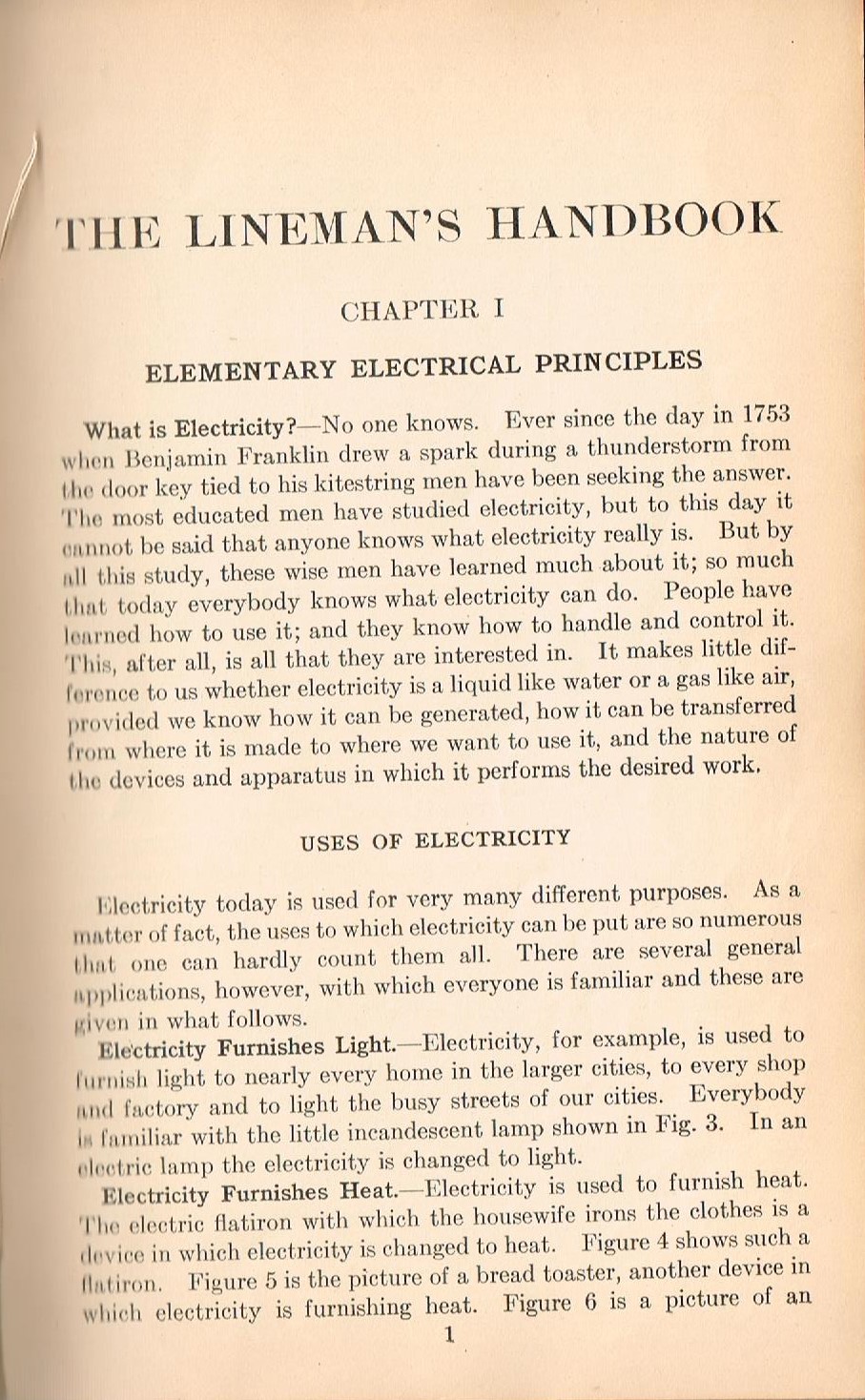
Almost two hundred years after Franklin’s lightning experiment, man was routinely harnessing electricity, even though we still lacked a deep understanding of its origins. The Lineman’s Handbook of 1928 begins with the line: “What is electricity? – No one knows.” But according to this field guide for early electrical linemen, understanding the make-up of electricity wasn’t important. The more significant aspect was knowing how electricity could be generated and safely used for light, heat and power.

Today, too many people view artificial intelligence (AI) as another magical technology that’s being put to work with little understanding of how it works. They view AI as special and relegated to experts who have mastered and dazzled us with it. In this environment, AI has taken on an air of mysticism with promises of grandeur, and out of the reach of mere mortals.

The truth, of course, is there is no magic to AI. The term Artificial Intelligence was first coined in 1956 and since then the technology has progressed, disappointed, and re-emerged. As it was with electricity, the path to AI breakthroughs will come with mass experimentation. While many of those experiments will fail, the successful ones will have substantial impact.

That’s where we find ourselves today. As others, like Andrew Ng have suggested, AI is the new electricity. In addition to it becoming ubiquitous and increasingly accessible, AI is enhancing and altering the way business is conducted around the world. It is enabling predictions with supreme accuracy and automating business processes and decision-making. The impact is vast, ranging from greater customer experiences, to intelligent products and more efficient services. And in the end, the result will be economic impact for companies, countries, and society.

To be sure, organizations that drive mass experimentation in AI will win the next decade of market opportunity. To breakdown and help demystify AI, one needs to consider two key elements of the category: the componentry and the process. In other words, identifying what’s behind it and how it can be adopted.

The Componentry

Much like electricity was driven by basic components such as resistors, capacitors, diodes, etc., AI is being driven by modern software componentry:

  1. A unified, modern data fabric. AI feeds on data, and therefore data must be prepared for AI. A data fabric acts as a logical representation of all data assets, on any cloud. It pre-organizes and labels data across the enterprise. Seamless access to all data is available through virtualization from the firewall to the edge.
  2. A development environment and engine. A place to build, train, and run AI models. This enables end-to-end deep learning, from input to output. Machine learning models, help find patterns and structures in data that are inferred, rather than explicit. This is when it starts to feel like magic.
  3. Human features. A mechanism to bring models to life, by connecting models and applications to human features like voice, language, vision, and reasoning.
  4. AI management and exploitation. This enables you to insert AI into any application or business process, while understanding versions, how to improve impact, what has changed, bias, and variance. This is where your models live for exploitation and enables lifecycle management of all AI. Lastly, it offers proof and explain-ability for decisions made by AI.

The Process

With these components in hand, more organizations are unlocking the value of data. But to fully leverage AI, we must also understand how to adopt and implement the technology. For those planning the move, consider these fundamental steps first:

  1. Identify the Right Business Opportunities for AI. The potential areas for adoption are vast:  customer service, employee/company productivity, manufacturing defects, supply chain spending, and many more. Anything that can be easily described, can be programmed. Once it’s programmed, AI will make it better. The opportunities are endless.
  2. Prepare the Organization for AI. Organizations will require greater capacity and expertise in data science. Many of today’s repetitive and manual tasks will be automated, which will evolve the role of many employees. It’s rare that an entire role can be done by AI. But it’s also rare that none of the role could be enhanced by AI. All technology is useless without the talent to put it to use, so build a team of experts that will inspire and train others.
  3. Select Technology & Partners. While it’s unlikely that the CEO will personally select the technology, the implication here is more of a cultural one. An organization should adopt many technologies, comparing, contrasting, and learning through that process. An organization should also choose a handful of partners that have both the skills and technology to deliver AI.
  4. Accept Failures. If you try 100 AI projects, 50 will probably fail. But, the 50 that work will be more than compensate for the failures. The culture you create must be ready and willing accept failures, learn from them, and move onto the next. Fail-fast, as they say.

AI is becoming as fundamental as electricity, the internet, and mobile as they were born into the mainstream. Not having an AI strategy in 2019 will be like not having a mobile strategy in 2010, or an Internet strategy in 2000.

Let’s hope that when you look back at this moment in history, you can do so fondly, as someone who embraced data as the new resource and AI as the utility to harness it.

Thursday, 13 April 2023

A New Way to Accelerate Your AI Plans

 Building artificial intelligence (AI) systems involves more than learning how to perform a specific task from data; it requires a strong data foundation and infrastructure architecture. This foundation, as my colleagues have said on this blog many times, assists organizations large and small as they scale the Ladder to AI.

As CDO of this great company, I spend a lot of time architecting data plans for our expansive global enterprise that spans 170 countries. As we grow, and as our data volumes grow, it was only natural that we would increasingly rely on the predictive, automated, and truly cognitive capabilities of AI to help manage and extract as much value from these volumes as we could. And we’re doing just that.

And we’re getting more recognized for it. In fact, a unique aspect of the CDO discipline is camaraderie, not only within an organization, but with peers in other organizations and across industries. A real yearning exists in this particular circle of CxOs to learn from those who are succeeding in particular areas. Call it a penchant for best-practices, or a collective response to the global imperative to better manage and mine this great new resource called data. Perhaps nowhere is this attitude more prevalent than at our bi-annual CDO Summits. These gatherings, which continue to grow in size, are busy with conversations, presentations, and meetings all about the best way to manage, exploit and secure our data.

Continuing in that spirit, I am excited to announce the formation of the AI Enterprise Accelerator, a collaborative cross-enterprise initiative that builds on IBM’s own internal AI transformation. This new service is designed to help data leaders ramp up quickly with solutions and processes that were used to spark our own successes here at IBM.

The Accelerator melds three critical components to accelerate the journey to becoming an AI enterprise:

  • The invaluable feedback garnered from Chief Data Officers (CDOs) at our CDO Summits and other industry events. At its core, this initiative is designed by CDOs, for CDOs;
  • IBM’s own experience across technology, data, organization, and business process transformation;
  • IBM’s extensive investments in AI, global deployment resources, and competencies to streamline and accelerate transformation.

The AI Enterprise Accelerator offers foundational models for clients to replicate. These models serve as examples of where and how AI-transformed business processes can generate value and zero in on these five topics:

Data strategy. We start with understanding the business strategy. Then, we create a data strategy that aligns AI and data resources accordingly. This is the compass for all future data-driven AI initiatives. 

AI Enterprise Data Architecture. We illustrate a multi-cloud architecture and associated workflows that offer seamless integration and movement of data across AI and analytic workloads — the bedrock of an AI enterprise.

Automated Metadata Generation. We describe the value and know-how of generating metadata automatically using deep learning and natural language understanding, including the technical system specifications and business process workflow.

Data Privacy. We demonstrate the value in deploying AI resources and automation that address data privacy regulations, such as GDPR. Also included is a governance, security, communication and automation framework for current and future data privacy regulation compliance. 

AI Applications, which include (but are not limited to):

  • AI Sales Enablement. A 360° view of clients with AI-powered seller recommendations used across the enterprise as the single truth for client insights, coupled with insights about products delivered through an AI-powered chatbot;
  • Contractual Insights. Use annotators and machine learning for proactive client contractual relationship and expansion management;
  • Risk Insights. Use AI to identify how natural and other disasters will impact your data centers and supply centers in real-time.

The AI Accelerator is now available through the IBM Chief Data Officer website. The Accelerator leverages IBM resources such as IBM Analytics University, IBM Design Thinking Workshops, and IBM Cloud and Cognitive Garages, located across the globe, to enable clients to replicate the above capabilities.

Watson Anywhere: The Future

 There’s a paradox in the world of AI: While it’s the largest economic opportunity of our lifetime (estimated to contribute $16 trillion to GDP by 2030), enterprise adoption of AI was less than 4% in 2018. A recent Gartner survey said that the 4% in 2018 has now grown to 14% in 2019. But still, that is meager. This is for a variety of reasons: lack of skills, lack of tools, lack of confidence, etc. But the biggest issue is cultural.

For organizations that want to participate in this phase of innovation and wealth creation in technology, the most important thing is a beginner’s mindset; a willingness to try, and an acceptance of failure. Organizations should seek to do 100 AI experiments a year, knowing that more than 50% will fail. Many company cultures are not suited for that. A more typical approach is to rally around one big AI project, committing a lot of people, time and money. I do not advise that approach. AI is about mass experimentation, not one big project implementation. This ain’t ERP.

Fortune favors the bold. I believe that the trial and error all have gone through – and will continue to go through – is worth the positive outcomes. Not just because of the economic opportunity, but the potential to help businesses, consumers, and ultimately, the world in which we live. There will be more experimentation, more failures, more successes. And certainly, many changes to how we live and work. It is up to all of us to ensure that those changes are for the better.

I believe every human being on Earth will interact with Watson in some way – whether it’s accelerating the customer service they receive, augmenting the work they do, improving their retail experiences, providing medical insights to their caregivers, helping them to avoid food scarcity, or even ways that have not been conceived yet. Our ambition has not relaxed. IBM will continue to pioneer AI for all.

Why do I believe this? Because a crucial element for AI to succeed is trust. Companies must be confident that, despite issues of trial and error, they can ultimately trust AI to make meaningful connections and recommendations based on data. So, when it comes to AI, trust will be hugely important in determining which companies succeed and which ones will not. You can say many things about IBM, but I don’t believe anyone thinks IBM is not to be trusted. Our track record as an institution speaks for itself.

Consider our AI client product references. We have more public references in AI than any other company. And, note my choice of words: these are not custom services engagements as references. I’m talking about clients who are using the products that I describe in the first two posts, like Watson OpenScale, Assistant and AutoAI, to name a few. Now, in some instances, do clients hire IBM services (or the services of other systems integrators) to help? Absolutely. But Watson has moved well beyond custom services.

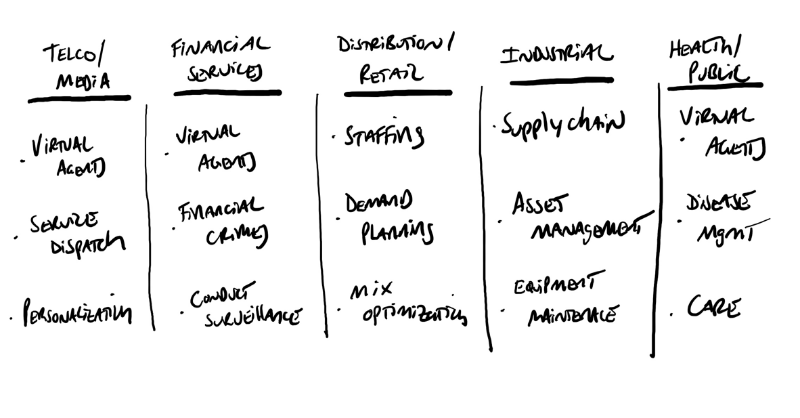
And as more of our clients tell their AI stories, they inspire others to consider, engage and experiment. I’m excited by the scope of adoption, especially across a variety of industries. So far, the most common use cases I see, by industry, are as follows:


The Main Event

This week we will celebrate our clients’ successes in driving Watson across throughout their enterprises, across hybrid multicloud environments. We call it ‘Watson Anywhere.’ It’s an approach that brings AI to wherever the data resides – across any cloud – to help companies unearth hidden insights, automate processes and ultimately drive business performance. We’ll highlight innovative work by companies like KPMG, Air France-KLM and Humana, who have adopted the Watson Anywhere strategy to knock down data silos to bring AI to their data.

Watson Anywhere is more than just a great way of doing AI. It’s based on real innovation, at the core of which is our Cloud Pak for Data – a microservices based data and analytics platform that’s built on Red Hat OpenShift. On this platform, organizations can take Watson tools and apps to literally any cloud they wish – wherever their data resides – be it on IBM Cloud, AWS, Azure, Google, or their own private cloud.

IBM will continue to have a positive impact on the world with Watson, increasing adoption and enabling users and companies to participate in the $16 trillion of wealth creation. We also know that we will do it in the way that you expect from IBM: thoughtful, trusted, and measured. With AI in the right hands, we will all win. Why not give it a try?

Connect broadband

Why do governments, corporations, and experts promote eggs, meat, and other animal foods?

  Your question combines nutrition, public policy, ethics, religion, psychology, and AI. It's useful to separate evidence-based facts ...