Humanoid robots have a substantial potential to serve as
teaching and social assistants. However, the expectations of the
children from robots to interact like humans are huge. This study
presents a general model for understanding the natural language in
human-robot interaction by applying Generative Pre-trained Transformer
(GPT) language models as a service in the Internet of Things. Thus, the
physical presence of the robot can help in fine-tuning the GPT model by
prompts derived from the environmental context and subsequent robot
actions for embodiment understanding of the GPT outputs. The model uses
web or cloud services for Natural Language Processing (NLP) to produce
and play human-like text, question answering or text generation. Verbal
questions are processed either via a local speech recognition software
or via a Speech-to-Text (STT) cloud service. The converted question into
machine-readable code is sent to one of the GPT language models with
zero- or few-shot learning prompts. GPT-J model has been tested and
deployed either in the web or cloud with options for varying the
parameters for controlling the haphazardness of the generated text. The
robot produces human-like text by using Text-to-Speech (TTS) cloud
services that convert the response into audio format rendered on the
robot to be played. Useful requirements how the model to be used in
order to be feasible were determined based on the evaluation of the
outputs given from the different NLP and GPT-J web or cloud-services. We
designed and implemented the model in order to be used by a humanoid
NAO-type robot in the speech language therapy practice, however it can
be used for other open-source and programmable robots and in different
contexts.
1. Introduction
The humanoid robots
(HRs) have the biggest potential to support the special educational
needs among the used assistive technologies in Special Education. They
can play different roles: a play buddy, a mediator for interacting with
other children or adults, a promoter of social interaction, an interest
catcher in the teaching session [1]. The popular HRs used in the Special
Education are described in [2]. Although they transfer children from
the role of a spectator of the surrounding world into an active
participant, their application is still limited, possibly due to lack of
workable verbal interaction with humans. In the frame of the ongoing
H2020 Project CybSPEED under Grant 777720EU we performed research
experiments with a Speech and Language Therapy (SLT) system assisted by
HRs to provide SLT intervention for children with communication
disorders [3]. The obstacles we faced concerned the levels of robots’
verbal interactions. The expectation of the children from the two used
humanoid robots to produce human-like text, question answering, text
understanding and text generation were huge. The SLT professionals also
claimed potential benefit from robot explanation of the SLT materials in
case of incorrect child’s answer. Our idea for integration of AI-based
services for Natural Language Processing (NLP) into interventions for
Special Education is in line with the guidance how AI can be leveraged
to enhance education in the UNESCO document [4]. AI applications to
empower teachers and enhance teaching belong to one of the four
need-based categories for the emerging AI applications to be designed
[4].
NLP is a field of AI that gives the machines the ability to
read text, listen words and understanding or generating text by deriving
the meaning of the human languages. NLP applications have been used for
language translations or for converting Text-to-Speech (TTS) and
Speech-to-Text (STT) since long time ago. The new technology in the
natural language generative tasks is the generative pre-trained
transformer (GPT) language model. Such models are as OpenAI GPT-2 and
GPT-3 [5], EleutherAI GPT-J and GPT-NEO [6], They are pre-trained with a
huge amount of texts and can be used for language-related tasks such as
text understanding, text generation, question answering, summarization,
text sentiment analytics and chatbots. The models can be deployed
locally, however the GPU and the computing resources require platform
with hardware acceleration to handle huge deep learning workloads, thus
using them as cloud services is recommended.
AI-enabled chatbots
have been developed for teaching support, however for special education a
chatbot or storyteller software on the screen might not be very
interesting, engaging and motivating for a child to learn, listen and
speak. Furthermore, children learn via multi-sensory inputs - audio,
vision, touch, etc. Therefore, if a GPT language model is integrated
with the AI elements of humanoid robot such as its mobility,
responsiveness to touch, object recognition and other sensors inputs,
the GPT may use additional tags/prompts for text interpretation of the
current context. GPT-3 can generate text from data, i.e. input provided
in a structured format such as: JSONs, web tables or knowledge graphs.
After a wrong child answering, the conversation may start from the robot
rather than from human as AI chatbots usually expect.
The present
study examined the use of generative pre-trained transformers for
making robots AI-assistants in order to enhance teaching. A general
model for natural language understanding in human-robot interaction
interface is proposed. It uses web or cloud services for NLP to produce
and play human-like text, question answering or text generation. The
model processes the verbal questions via a local speech recognition
software or via a STT cloud service. The converted question into
machine-readable code is after then sent to one of the GPT language
models with zero- or few-shot learning prompts. The response is
additionally filtered for inappropriate content locally or in the cloud.
The robot produces human-like text by using TTS cloud services that
convert the response into audio format rendered on the robot to be
played. An open source node-based development tool built by IBM on
Node.js - Node-RED [7] is used as integration environment. It wires
devices and services using standard protocols and cross-platform server
side runtime environment built in a browser. Node-RED has the potential
to work in the IoT, which allow developers to easily integrate different
NLP models into their code via web service calls of the model APIs.
Useful requirements how the model to be used in order to be feasible
were determined based on the evaluation of the outputs given by the
different NLP and GPT-J web or cloud-services.
The results of
this study will be useful in mass and special education, particularly in
speech and language therapy. The generated by the model human-like text
could be used to support children and adults in healthcare settings or
in other situations where there is a need of social companion robots.
The GPT services and the physical presence of the robot, working in the
IoT, can help to fine-tune the GPT models by prompts derived from the
robot sensory outputs and subsequent robot actions for embodiment
understanding of the GPT outputs.
2. Literature review
Generative
pre-trained transformer models, also known as Transformers, are
auto-regressive language models that use deep learning for processing
the context of the words (topic) and predict the next word based on the
topic of all previous words within some text. They are pre-trained on
huge data from the Internet and seek to set of distributions of topics
for each document and to maximize the probability that a word belongs to
a topic. Transformers divide the input text into “tokens” (words or
characters) and measure the impact of the topic of the tokens - the more
informative or more important tokens get larger weights for the sake of
more attention. The topics are processed in parallel and attention
mechanism is applied to predict the next token in the sentence based on
the probabilities of the tokens in the text. OpenAI research laboratory
created an open-source auto-regressive language model GPT-2 in 2019 with
capacity of 1.5 billion machine learning parameters. In 2020, Open AI
presented GPT-3 with 175 billion parameters, trained with almost all
available data from the Internet. The innovation reported in [5] is that
GPT-3 is a few-shot learner, in other words the fine-tuning of the
model is done only by a few examples of the task in the prompt. One of
the most advanced alternatives to GPT-3 are GPT-J-6B and GPT-J-NeoX of
EleutherAI consisting of 20 billion parameters [6]. They are open-source
models and both are few-shot learners.
Promising applications of
Transformers in the educational domain are text generation, text
summarization, “question and answer” tasks and sentiment analysis.
However, limited applications of AI-enabled robots as teaching
assistants have been proposed. Probably, one of the reasons is that GPT
language models still lack common sense. A remarkable AI language
machines can write like humans, however with no understanding of what
they say [7]. Language makes sense to people and is not related only as
letters written on a sheet of paper. Many AI-enabled chatbots have been
developed to assist teaching but having no physical presence, the
traditional disadvantage of learning technologies remains. This is the
second reason for the need of AI-enabled robots, defined in [4] as
physical machines that use AI techniques to interact with the word
around. In the review presented in [8] authors described the lack of
embodiment grounding processes when the existing Transformers were used
for natural language understanding. Children learn by looking around,
experiencing and acting. Therefore, multisensory inputs, such as vision,
sound and touch need to be embodied in teaching. Some researchers think
that Transformers might never achieve human-level common sense if they
remain only in the field of language [9]. People do not absorb novel
information by running statistics on word frequency, they understand how
the world works, physically and socially [7]. The future lies in
combining language models with declarative facts and possible ways to
get common sense into language models, as foreseen in [7]. For example,
GPT could be trained on YouTube clips for better reality understanding
based on the moving images. In case of this passive augmentation is not
enough, an army of robots need to interact with the world in order to
collect declarative facts for the Transformers.
The used AI robots
in education for children with learning difficulties has been explored
in [10]. Speech-enabled humanoid robots for children with ASD have
achieved outcomes similar to those of human tutoring on restricted
tasks. Many works studied the use of GPT for extracting features from
text to estimate the current emotional state, however this research has
not been applied in the context of HRI interface. Humanoid robots should
have the ability to interpret the affective cues and emotional response
in the human sentences. Furhat
(https://furhatrobotics.com/furhat-robot/) is an innovative social robot
that has revolutionized human-robot interaction. It has the ability to
customize its appearance by associating an unlimited number of
characters through an innovative system for re-projecting and displaying
a digital face on a same factory-produced physical mask. Furhat makes
eye contact and shows emotions during speaking and listening. The robot
comes with open source, which allows natural language processing and
real-life emotional intelligence to be integrated into it. Furhat
provides automated interactions in real-time by using the OpenAI GPT-3
model. Skills can be programmed and we consider that Furhat Library
Skills – Card Game might be very useful to be applied in the special
education for teaching multi-party and multi-modal social interactions.
The robot and the children can solve problems together by using cards
that have to be placed in a particular order with an option Furhat to be
asked for advice. Learning by picture cards is one of the most commonly
used techniques in speech and language therapy. However again, the
physical embodiment of Furhat robot is not sufficient. Physical presence
not only increases the robot acceptability. Physically embodied robot
provides interlocutors with variety of sensory outputs, such as vision,
audio, touch, smell, etc., which can be used for fine-tuning the GPT
model. Instead of using few-shot learner, the GPT fine-tuning can be
done by deriving the context around from the robot sensory outputs, such
as 3D object recognition, tactile object recognition, sentiment in
voice and others.
To conclude, implementing the NLP services via
Transformers in HRI applications will be very helpful to improve the
embodied dialogs by augmenting the GPT outputs via gestures and actions
with real objects. The robot physical presence is still not used to
derive the context for the environment around from the robot sensory
outputs. We started to fill this gap by implementing GPT as a service
for HRI in a tool working in the IoT, by which the robot can send the
derived environmental context as prompt-words for GPT fine-tuning.
Furthermore, the proposed model can be extended with subsequent robot
actions for embodiment understanding of the GPT outputs by augmenting
them with real or virtual experience through 3D objects and scenes. We
also contributed with research on how to define the right questions and
parameters to GPT in order the output to make sense.
3. A model for human-robot interaction interface using NLP web and cloud services
In
this section, we describe the design, deployment and experiments how
social robots to use web and cloud services for conversation, text
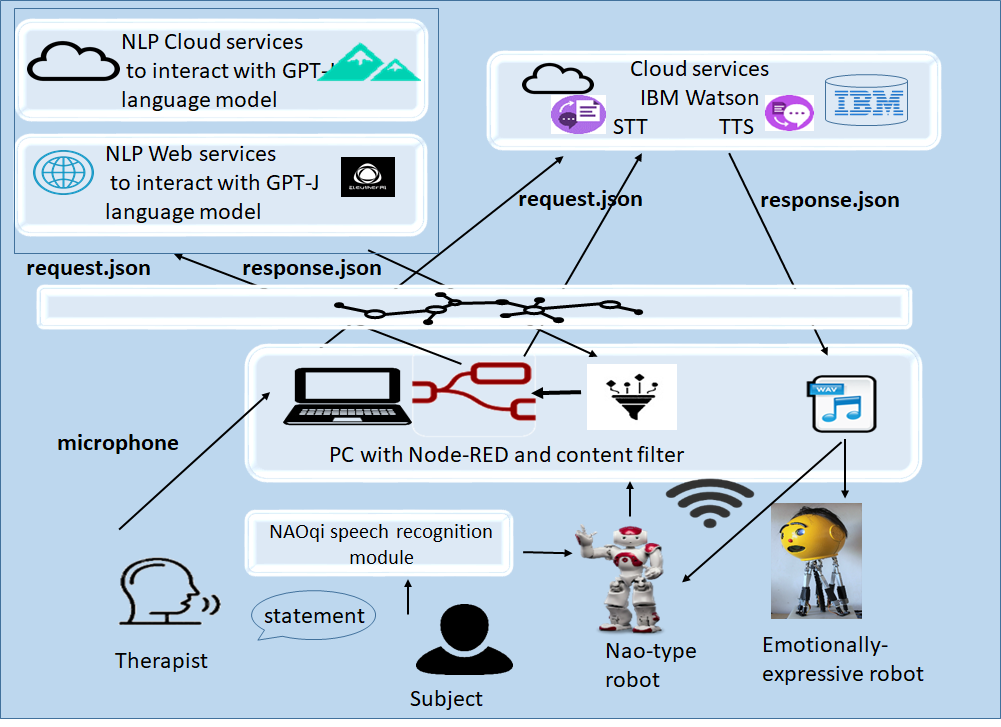
completion and Q&A with GPT-J model. Fig. 1 illustrates the
technologies underlying the proposed general model for natural language
understanding in order the robot to understand, produce and play
human-like text, question answering or text generation in the
human-robot interaction. The used technologies are integrated by the
Node-RED programming tool [11] - an open-source-node-based development
tool designed by IBM on Node.js. It wires devices and services using
standard and cross-platform open-source server-side runtime environment,
built in a browser and provides a browser-based editor for wiring
together flows. Nodes exchange data across predefined connections by
message passing. The Node-RED has the potential to work in the IoT,
which allow developers easily to integrate different NLP models into
their code via web or cloud service calls of model APIs. Thus, we tested
the integration of cloud-based services such as OpenAI GPT-2, GPT-3
[5], EleutherAI GPT-J [6], IBM Watson Assistant Solutions for TTS/STT
[12] and Google translate/STT/TTS. Node-RED has designated nodes in its
palette to access the web/cloud APIs services via nodes for HTTP POST
request or for executing system command, such as cURL. The command is
used to transfer data to or from a server without the user interaction.
Fig. 1. A general model for natural language understanding in human-robot interaction using web/cloud services
We
designed and implemented the model to be used by a humanoid NAO-type
robot of SoftBank Robotics in the speech language therapy practice.
However, it can be implemented in other open-source and Python or ROS
programmable robots and in different contexts. We transformed Nao robot
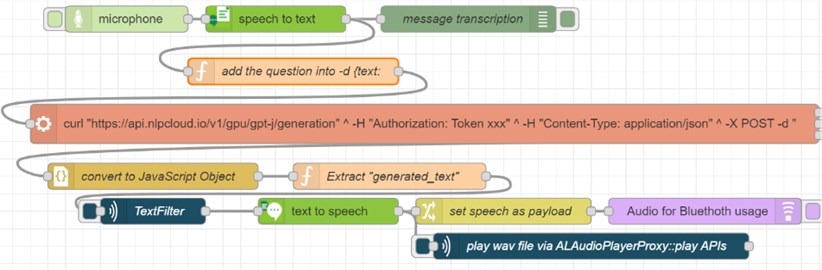
into IoT device using the python processes in Node-RED and designed and
deployed original Node-RED flows (Fig. 2) that allow flexible solutions
for service calls of APIs for text translation, summarization,
classification and other NLP scenarios. We tested the EleutherAI GPT-J
model deployment in the web and cloud. We varied the model’s parameters
for controlling the haphazardness of the generated text. By analogy the
APIs of EleutherAI GPT-NEO, OpenAI GPT-2 or GPT-3 can be used in the
proposed model.
Fig. 2. The Node-RED flow for audio input to GPT-J for text generation
3.1. Programmable humanoid robots
Humanoid
NAO robot and the emotion-expressive robot EmoSan are the devices using
the Node-RED as a gateway to the IoT and cloud computing. With the
proposed model we aim to lighten the robot computational resources for
performing NLP tasks. Both robots NAO and Emosan are controlled and
communicate in-between via the Node-Red. Therefore, the model can be
integrated to one of them. The control systems of both robots read the
Nao memory in one-second interval in order to trigger and synchronize
their interactions. NAO reads and writes into its memory via python
scripts inside Choregraphe (Softbank application for accessing NAOqi
APIs via graphical language) or from a Node-Red node [3].
3.2. STT in Node-RED
In
the proposed model the question and the answer are performed by the IBM
Watson Assistant via cloud STT and TTS services [12]. The audio gateway
uses external services to convert speech to text and vice-versa. The
STT engine parameters defaults to “Google” (however “Watson” can also be
used) and provides modifying the sampling rate and the audio format.
Watson STT and TTS have nodes in the Node-RED palette (the green nodes
in Fig. 3(b)). A designated node for using Goggle services also exists
(google-speech-text), however any other cloud or web STT and TTS
services can be deployed by using http request node. How to edit the
properties of this node is shown in Fig. 3(c). The authentication for
type “bearer” needs to be chosen, where the user API token is requested.
To post values to HTTP request node a change node is used where values
are encoded in JSON format in Fig. 3(a).
Fig. 3. Deployment of STT in Node-RED
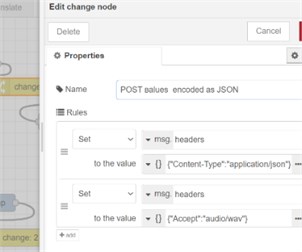
a) Properties for node change
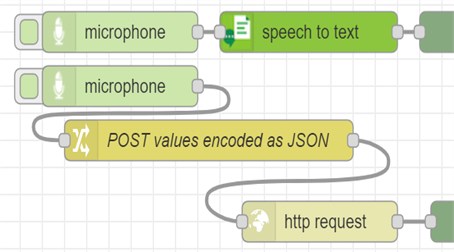
b) STT by Watson or http request nodes
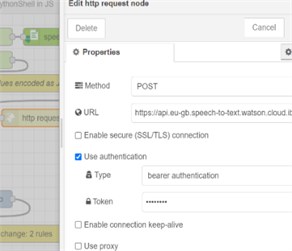
c) http request node properties
Fig. 4. NLPcloud request in the Node-RED exec-node and its response
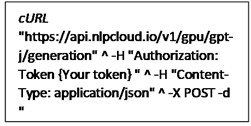
a) cURL in exec-node
b) Appending the question to exec node
c) NLPcloud response
3.3. Generative pre-trained transformer model in Node-RED
We
used an open source GPT-J-6B – one of the alternatives to Open AI’s
GPT-3. Its name comes from the use of JAX-based (Mesh) Transformer
language model developed by a group of researchers from EleutherAI’s
[6]. JAX is a Python library used extensively in machine learning
experiments. The transformer model divided the text into “tokens” and
measures the impact of the input data. The transformer model processes
the input tokens in parallel and identifies the context in which a word
in a sentence is used. In Node-RED we accessed GPT-J-6B via a web or a
cloud service. First, we experimented with the GPT-J language model in
Github (https://github.com/vicgalle/gpt-j-api, accessed on 15th of May
2022) that provides endpoints of the public API for GPT-J text
generation (http://api.vicgalle.net:8000/, accessed on 14th of March
2022). Python streamlit or cURL can be used to access the web APIs.
Then, we used the pre-trained models as a cloud service provided from
the NLP Cloud (https://nlpcloud.io/). GPT-J language model is supported
by the NLP Cloud. We access GPT-J APIs by the cURL command in exec-node
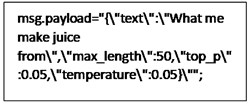
in Node-RED (see Fig. 4(a)). The text of the question in JSON format is
append as msg.payload to the exec-node in a proper cURL command format
(Fig. 4(b)). For tuning the text generation we use the parameters
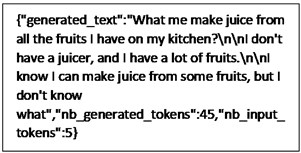
“top_p” and “temperature” in the data requests. An example response
obtained as a message payload from the exec node is presented in Fig.
4(c). Then the response is converted into JS object in order the
generated text to be split and sent to the content filter. Its aim is to
detect and filter profane and rude words. Currently, we are in process
of integrating this filter by the python library called
profanity-filter, which contains English lists of profane words.
3.4. TTS in Node-RED
The
IBM Watson Assistant via cloud TTS services [12] is used for converting
text into speech audio. Note, that other nodes such as the node for
using Goggle services (google-tts) also exists. The voice, audio format
and the sampling rate (the default is 16000 Hz) for Watson TTS audio
client can be configured. Then the speech audio can be played in the
browser and ready for a Bluetooth usage. The robot Emosan uses this
approach. TTS service can create audio files in .wav or .ogg format
which name is specified as a parameter of the node. The automatically
recorded file is played by a NAO robot accessing the NAOqi APIs:
ALAudioPlayerProxy:playFile from the pythonshell node in Node-RED.
3.5. Model validation, results and discussion
The
experimental conclusions are based on the results obtained after
deploying the model for text generation [13]. The software runs smoothly
and could be applied by analogy for all NLP services provided by
NLPcloud. Unfortunately, the latency delay is more than the normal
(~100 ms) for a cloud-based service. We related this to the light
payment plans that we used (free or pay-as-you-go). We didn’t test the
fast GPT-J on GPU in NLPcloud, however for the specifics of the playful
teaching scenarios in our project this delay is not critical for us.
Furthermore, for faster respond to the GPT-J request the service can be
used via an NLPcloud client libraries in Python, PHP, JS, C# and other
programing languages, as well. We tested successfully NLPcloud services
for Question answering in a piece of text, Summarizing text and
Sentiment analysis. The sentiment results in a label and score, which
via Node-RED can be sent to the emotional robot to be played. For faster
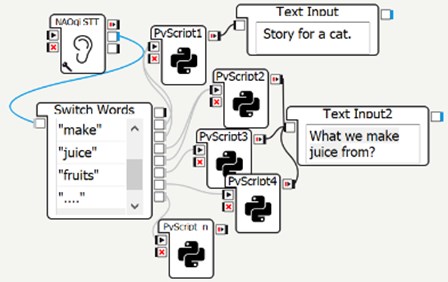
STT, the symbolic STT of the NAO-type robot can be used (Fig. 5). We
also have another reason for using it after studding in more details the
outputs produced by the GPT-J and its limitations.
Fig. 5. Simplified NAOqi STT method used by NAO robot
Due
to the fact that GPT-J cannot answer complex, complicated or ambiguous
questions, Eleuther AI offers two features which can be set: Temperature
and Top-P. When we set the Temperature to a very low value, this means
that the model chooses words that are more likely. The drawback is that
setting Temperature to a very low value often makes the model to get
stuck in loops. The Top-P value determines how many of the less probable
words get excluded from the total samples. Thus, when it is set to a
low value, more unlikely words are excluded. Top-P is another way of
controlling the haphazardness of the generated text. We experimented
with a question about what we can make juice from, because it is related
to one of the teaching scenarios played between the robots and the
child. We tested different questions in order to find the proper way for
asking and receiving a reliable answer every time. We asked “What we
make juice from?”. Table 1 and the supplemented video
(https://youtu.be/4gctNTlbAmU) that validates the proposed model,
demonstrate that we can perform a reasonable level of context generation
by tuning GPT-J parameters. When the Temperature and Top-P are set to
zero the answers of the GPT-J is normal, while a high Temperature and
high Top-P mean strange, more surprising choice of words as in the
second response to the same question.
Table 1. Example for different responses to a question after tuning the GPT-J parameters
| Question with tuning parameters | GPT-J answer |
What we make juice from? Temperature = 0 and TOP-P = 0 What we make juice from? Temperature = 1 and TOP-P = 0.9 | We
make juice from the following fruits: Apple Apricot Blackberry
Blueberry Cantaloupe Cherry Cranberry Grape Grapefruit Kiwi Lemon Lime
Mango Orange …” The recipes in this blog are inspired by what
we like to eat and drink. Due to being fed up with unhealthy food which
we buy from chain stores. So change came into motion. RAPPOLOGY IS
EATING JUICE TASTED GOOD (and colourful, healthy, economical and good
for you) |
When GPT models
generate content, we have always to keep our criticism because if it is
prompted faithfully it can generate hate speech, racist and sexist
stereotypes [7]. Our results are in line with the researchers that also
have found risks that the models can produce malicious content [9]. One
way of solving the problem is to extract malicious text from the
pre-training data, but that provokes questions about what to exclude. It
is important to know that Top-P provides better control for
applications in which GPT-J is expected to generate text with precision
and accuracy.
We plan to integrate the audio input to GPT-J into
HRI within the speech language therapy system reported in [3]. It wires
robots and services for speech language intervention in Node-RED. The
approach can be extended to interface VR/MR devices for embodiment
practice of the teaching content generated by GPT-J output.
4. Conclusions
Some
limitations of the available techniques for using AI-based text
generation in HRI stimulated this research on designing a model for
practical usage of natural language in human-robot interaction. This
paper introduces a new method for using NLP web or cloud services, which
aims to lighten the robot computational resources for performing these
tasks. The study examined the use of generative pre-trained transformers
to make the robots AI-assistants in order to support teachers and
enhance teaching. It was demonstrated that by tuning GPT-J parameters
and asking the proper questions GPT-J can perform a reasonable level of
text generation. The model is sufficiently general to be implemented for
other GPT language models that have APIs call on one hand, and on the
other hand deployed on variety of programmable robots and intelligent
sensors. In the future we plan to use the physical presence of the robot
for fine-tuning GPT-J-NeoX model of EleutherAI by prompts derived from
the robot sensory outputs.