In the realm of inferential statistics, you often want to test specific hypotheses about our data. Using the Ames Housing dataset, you’ll delve deep into the concept of hypothesis testing and explore if the presence of an air conditioner affects the sale price of a house.
Let’s get started.
Overview
This post unfolds through the following segments:
- The Role of Hypothesis Testing in Inferential Statistics.
- How does Hypothesis Testing work?
- Does Air Conditioning Affect Sale Price?
The Role of Hypothesis Testing in Inferential Statistics
Inferential Statistics uses a sample of data to make inferences about the population from which it was drawn. Hypothesis testing, a fundamental component of inferential statistics, is crucial when making informed decisions about a population based on sample data, especially when studying the entire population is unfeasible. Hypothesis testing is a way to make a statement about the data.
Imagine you’ve come across a claim stating that houses with air conditioners sell at a higher price than those without. To verify this claim, you’d gather data on house sales and analyze if there’s a significant difference in prices based on the presence of air conditioning. This process of testing claims or assumptions about a population using sample data is known as hypothesis testing. In essence, hypothesis testing allows us to make an informed decision (either rejecting or failing to reject a starting assumption) based on evidence from the sample and the likelihood that the observed effect occurred by chance.
How does Hypothesis Testing work?
Hypothesis Testing is a methodological approach in inferential statistics where you start with an initial claim (hypothesis) about a population parameter. You then use sample data to determine whether or not there’s enough evidence to reject this initial claim. The components of hypothesis testing include:
- Null Hypothesis (
): The default state of no effect or no different. A statement that you aim to test against. - Alternative Hypothesis (
): What you want to prove. It is what you believe if the null hypothesis is wrong. - Test Statistic: A value computed from the sample data that’s used to test the null hypothesis.
- P-value: The probability that the observed effect in the sample occurred by random chance under the null hypothesis situation.
Performing hypothesis testing is like a detective: Ordinarily, you assume something should happen (
In a typical hypothesis test:
- You state the null and alternative hypotheses. You should carefully design these hypotheses to reflect a reasonable assumption about the reality.
- You choose a significance level (
); it is common to use in statistical hypothesis tests. - You collect and analyze the data to get our test statistic and p-value, based on the situation of
. - You make a decision based on the p-value: You reject the null hypothesis and accept the alternative hypothesis if and only if the p-value is less than
.
Let’s see an example on how these steps are carried out.
Does Air Conditioning Affect Sales Price?
Based on the Ames Dataset, we want to know if the presence of air conditioning can affect the price.
To explore the impact of air conditioning on sales prices, you’ll set our hypotheses as:
: The average sales price of houses with air conditioning is the same as those without. : The average sales price of houses with air conditioning is not the same as those without.
Before performing the hypothesis test, let’s visualize our data to get a preliminary understanding.
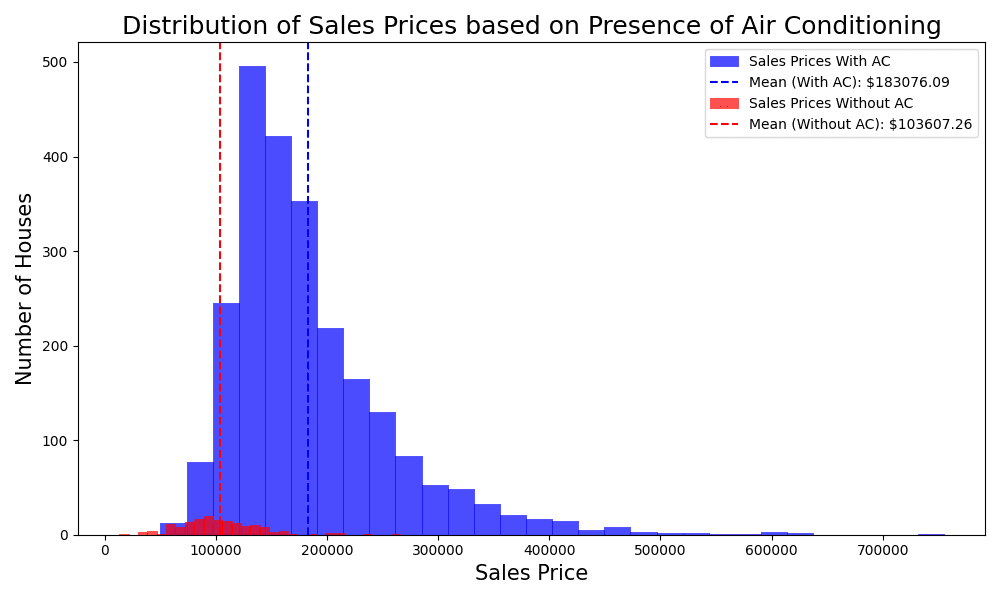
Overlapped histogram to compare the sales prices
The code above called plt.hist() twice with different data to show two overlapped histograms, one for the distribution of sales price with air conditioning (AC) and one without. Here are a few observations that can be made from the visual:
- Distinct Peaks: Both distributions exhibit a distinct peak, which indicates the most frequent sale prices in their respective categories.
- Mean Sale Price: The mean sale price of houses with AC is higher than that of houses without AC, as indicated by the vertical dashed lines.
- Spread and Skewness: The distribution of sale prices for houses with AC appears slightly right-skewed, indicating that while most houses are sold at a lower price, there are some properties with significantly higher prices. In contrast, the distribution for houses without AC is more compact, with a smaller range of prices.
- Overlap: Despite the differences in means, there’s an overlap in the price range of houses with and without AC. This suggests that while AC may influence price, other factors are also at play in determining a house’s value.
Given these insights, the presence of AC seems to be associated with a higher sale price. The next step would be to perform the hypothesis test to numerically determine if this difference is significant.
This shows:
The p-value is less than
This p-value is computed using t-test. It is a statistic aimed at comparing the means of two groups. There are many statistics available, and t-test is a suitable one here because our hypotheses
Note that the alternative hypothesis alternative="greater":
This changes the two-sided t-test to one-sided t-test, and the p-value should change.
Also note that, if p-value is small but not less than
Further Reading
Online
- Hypothesis Testing Tutorial
- scipy.stats.ttest_ind API
- Student’s t-test in Wikipedia
Resources
Summary
In this exploration, you delved into the world of hypothesis testing using the Ames Housing dataset. You examined how the presence of an air conditioner might impact the sale price of a house. Through rigorous statistical testing, you found that houses with air conditioning tend to have a higher sale price than those without, a result that holds statistical significance. This not only underscores the importance of amenities like air conditioning in the real estate market but also showcases the power of hypothesis testing in making informed decisions based on data.
Specifically, you learned:
- The importance of hypothesis testing within inferential statistics.
- How to set up and evaluate null and alternative hypothesis using detailed methods of hypothesis testing.
- The practical implications of hypothesis testing in real-world scenarios, exemplified by the presence of air conditioning on property values in the Ames housing market.
Do you have any questions? Please ask your questions in the comments below, and I will do my best to answer.






No comments:
Post a Comment