In languages, the order of the words and their position in a sentence really matters. The meaning of the entire sentence can change if the words are re-ordered. When implementing NLP solutions, recurrent neural networks have an inbuilt mechanism that deals with the order of sequences. The transformer model, however, does not use recurrence or convolution and treats each data point as independent of the other. Hence, positional information is added to the model explicitly to retain the information regarding the order of words in a sentence. Positional encoding is the scheme through which the knowledge of the order of objects in a sequence is maintained.
For this tutorial, we’ll simplify the notations used in this remarkable paper, Attention Is All You Need by Vaswani et al. After completing this tutorial, you will know:
- What is positional encoding, and why it’s important
- Positional encoding in transformers
- Code and visualize a positional encoding matrix in Python using NumPyTutorial Overview
This tutorial is divided into four parts; they are:
- What is positional encoding
- Mathematics behind positional encoding in transformers
- Implementing the positional encoding matrix using NumPy
- Understanding and visualizing the positional encoding matrix
What Is Positional Encoding?
Positional encoding describes the location or position of an entity in a sequence so that each position is assigned a unique representation. There are many reasons why a single number, such as the index value, is not used to represent an item’s position in transformer models. For long sequences, the indices can grow large in magnitude. If you normalize the index value to lie between 0 and 1, it can create problems for variable length sequences as they would be normalized differently.
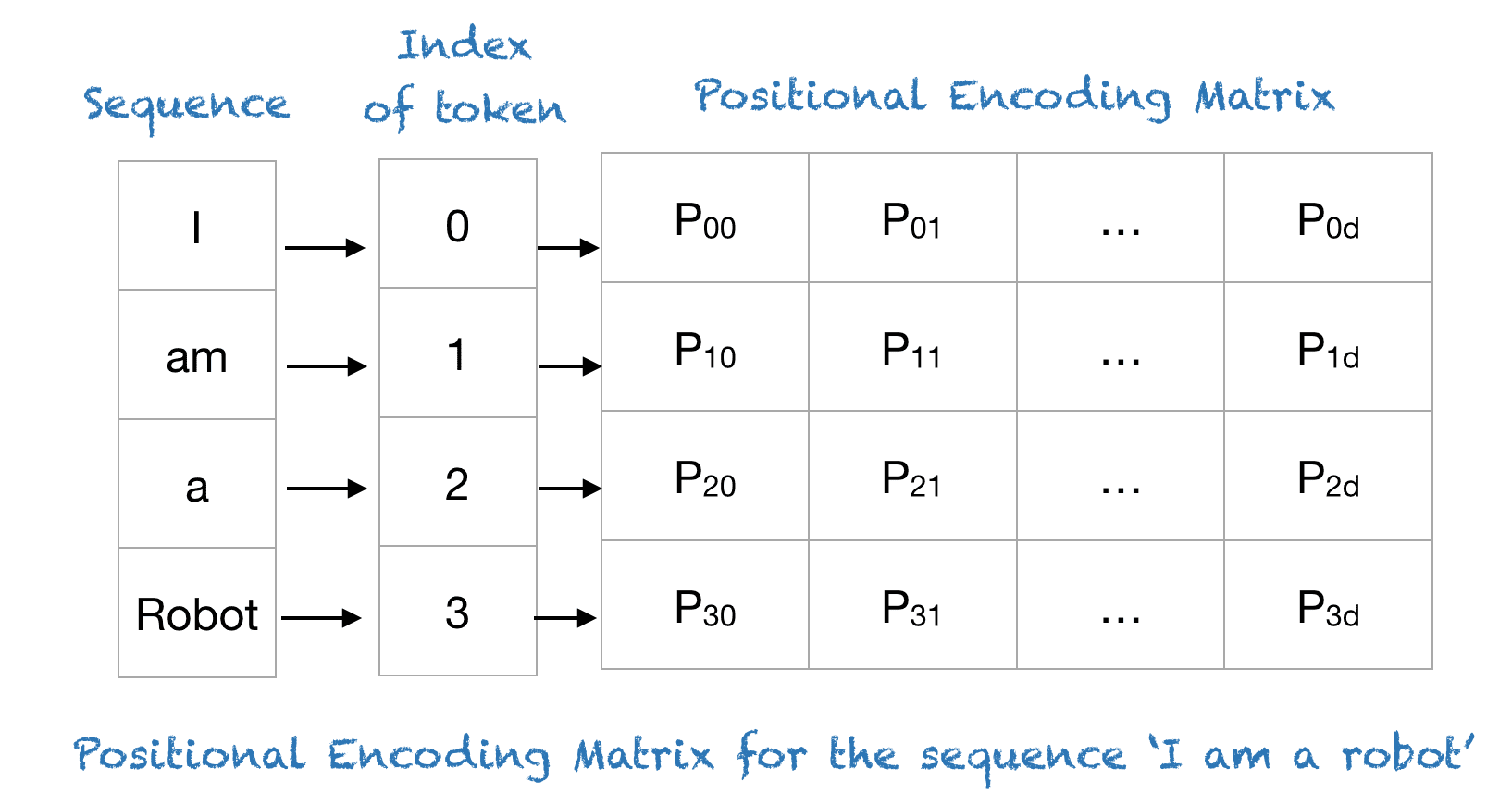
Transformers use a smart positional encoding scheme, where each position/index is mapped to a vector. Hence, the output of the positional encoding layer is a matrix, where each row of the matrix represents an encoded object of the sequence summed with its positional information. An example of the matrix that encodes only the positional information is shown in the figure below.
A Quick Run-Through of the Trigonometric Sine Function
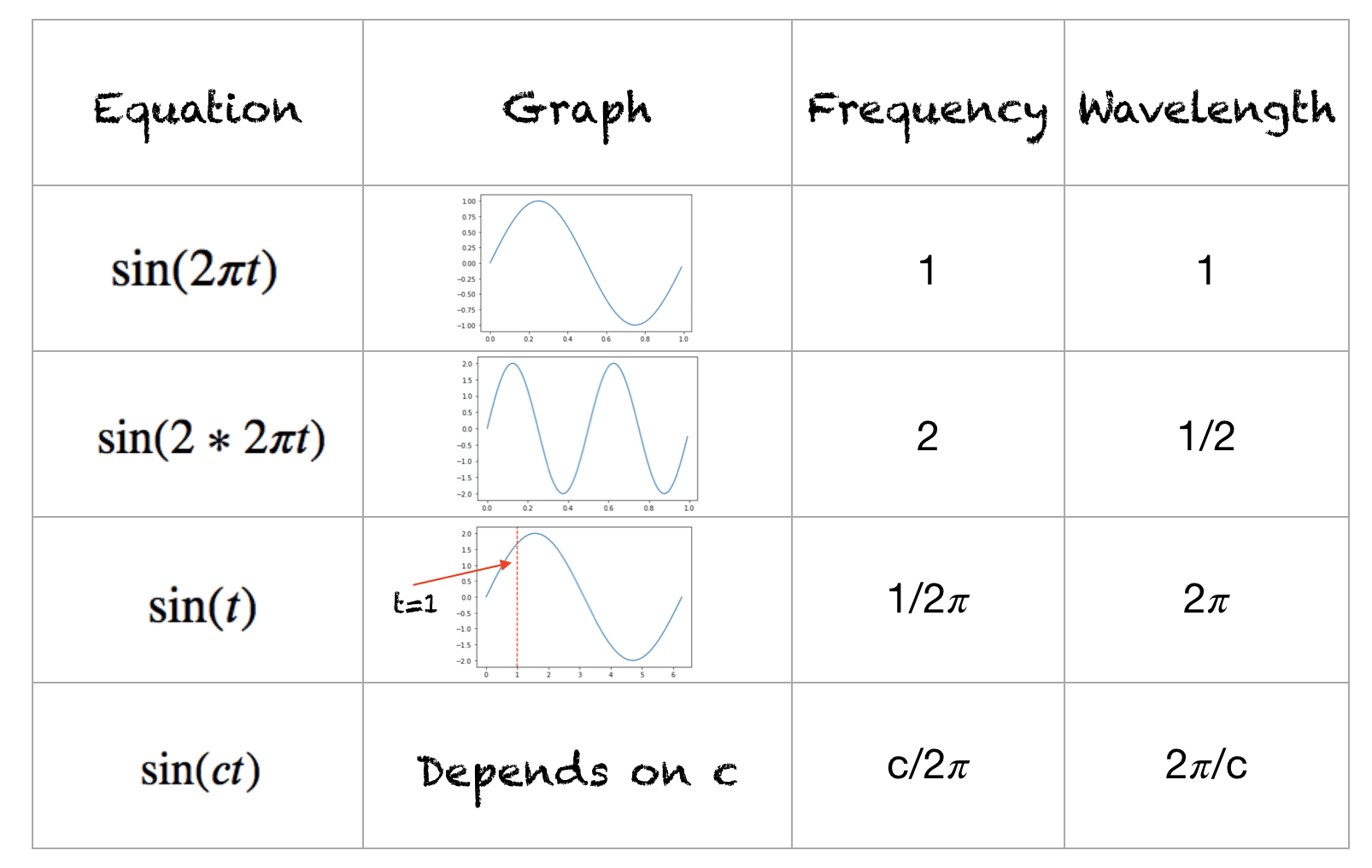
This is a quick recap of sine functions; you can work equivalently with cosine functions. The function’s range is [-1,+1]. The frequency of this waveform is the number of cycles completed in one second. The wavelength is the distance over which the waveform repeats itself. The wavelength and frequency for different waveforms are shown below:
Positional Encoding Layer in Transformers
Let’s dive straight into this. Suppose you have an input sequence of length
Here:
In the above expression, you can see that even positions correspond to a sine function and odd positions correspond to cosine functions.
Example
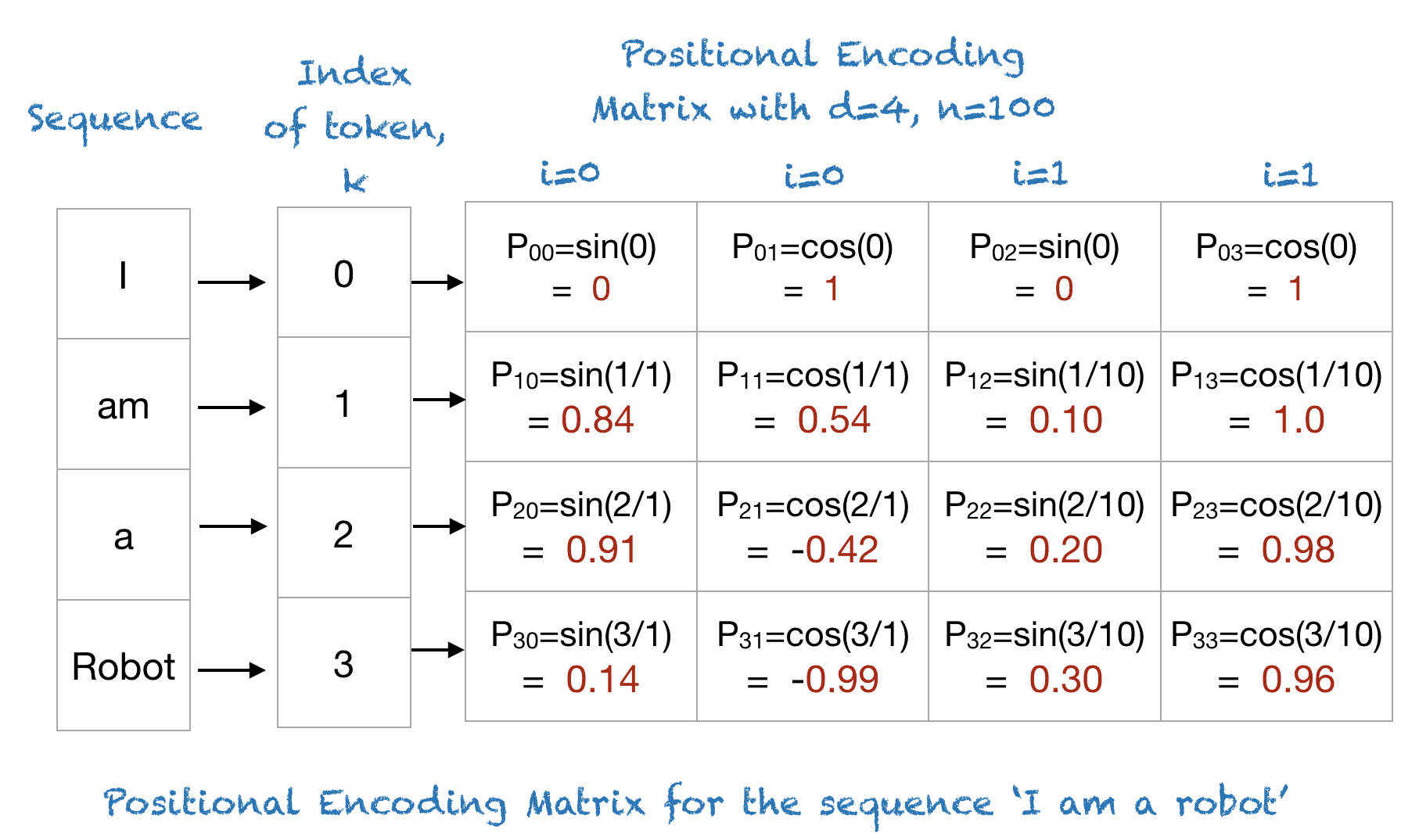
To understand the above expression, let’s take an example of the phrase “I am a robot,” with n=100 and d=4. The following table shows the positional encoding matrix for this phrase. In fact, the positional encoding matrix would be the same for any four-letter phrase with n=100 and d=4.
Coding the Positional Encoding Matrix from Scratch
Here is a short Python code to implement positional encoding using NumPy. The code is simplified to make the understanding of positional encoding easier.
Understanding the Positional Encoding Matrix
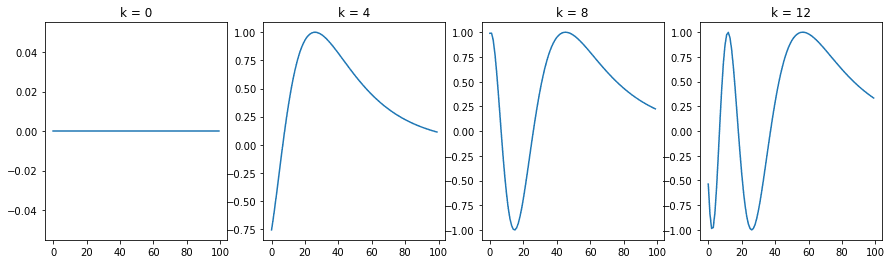
The following figure is the output of the above code:
Sine wave for different position indices
You can see that each position
Hence, the wavelengths of the sinusoids form a geometric progression and vary from
- The sine and cosine functions have values in [-1, 1], which keeps the values of the positional encoding matrix in a normalized range.
- As the sinusoid for each position is different, you have a unique way of encoding each position.
- You have a way of measuring or quantifying the similarity between different positions, hence enabling you to encode the relative positions of words.
Visualizing the Positional Matrix
Let’s visualize the positional matrix on bigger values. Use Python’s matshow() method from the matplotlib library. Setting n=10,000 as done in the original paper, you get the following:
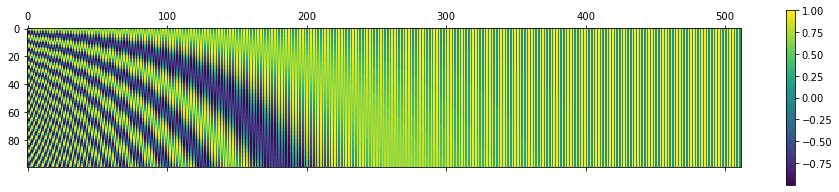
The positional encoding matrix for n=10,000, d=512, sequence length=100
What Is the Final Output of the Positional Encoding Layer?
The positional encoding layer sums the positional vector with the word encoding and outputs this matrix for the subsequent layers. The entire process is shown below.
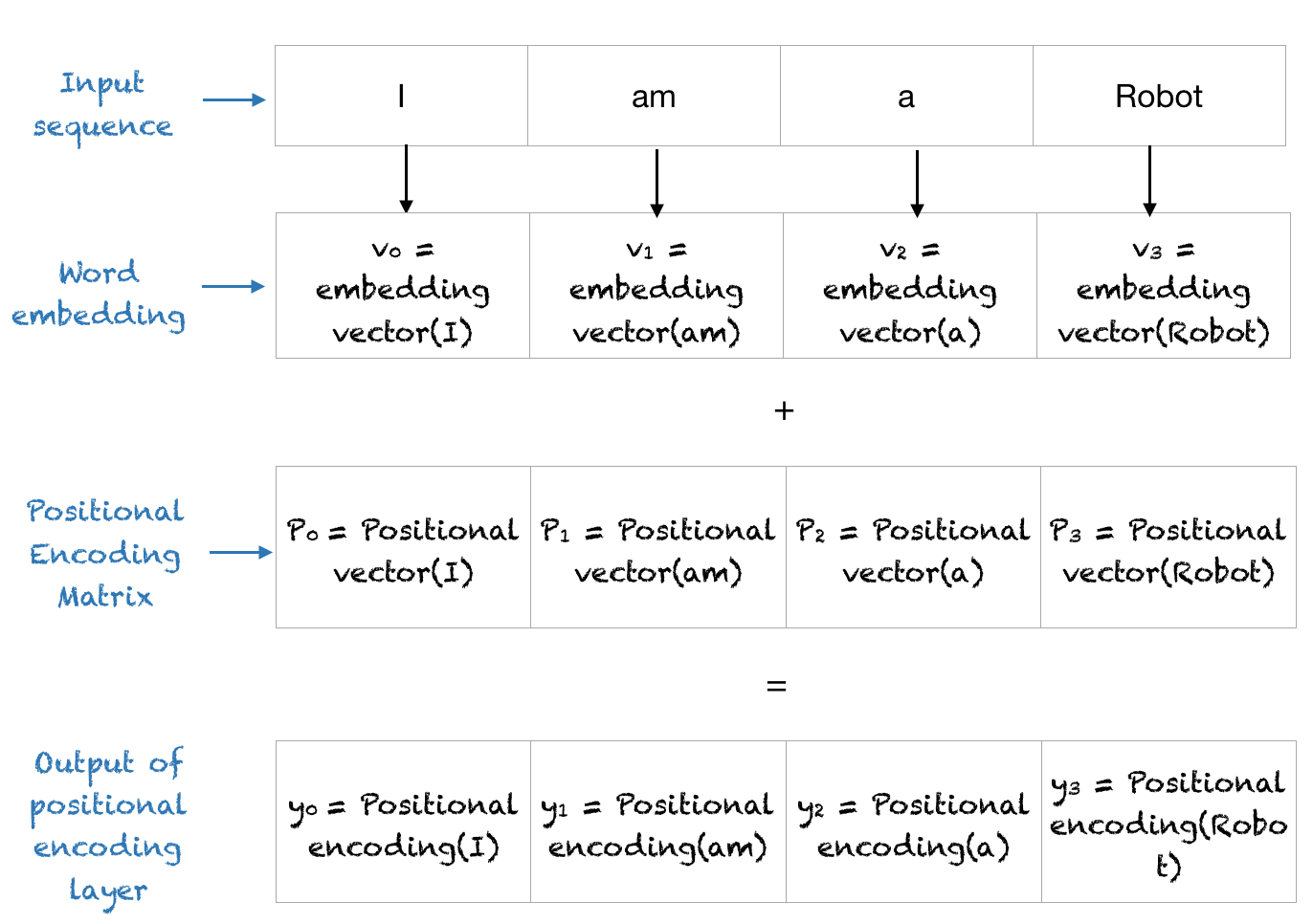
The positional encoding layer in the transformer
Further Reading
This section provides more resources on the topic if you are looking to go deeper.
Books
- Transformers for natural language processing, by Denis Rothman.
Papers
- Attention Is All You Need, 2017.
Articles
- The Transformer Attention Mechanism
- The Transformer Model
- Transformer model for language understanding
Summary
In this tutorial, you discovered positional encoding in transformers.
Specifically, you learned:
- What is positional encoding, and why it is needed.
- How to implement positional encoding in Python using NumPy
- How to visualize the positional encoding matrix
Do you have any questions about positional encoding discussed in this post? Ask your questions in the comments below, and I will do my best to answer.






No comments:
Post a Comment