Which machine learning algorithm should you use?
It is a central question in applied machine learning.
In a recent paper by Randal Olson and others, they attempt to answer it and give you a guide for algorithms and parameters to try on your problem first, before spot checking a broader suite of algorithms.
In this post, you will discover a study and findings from evaluating many machine learning algorithms across a large number of machine learning datasets and the recommendations made from this study.
After reading this post, you will know:
- That ensemble tree algorithms perform well across a wide range of datasets.
- That it is critical to test a suite of algorithms on a problem as there is no silver bullet algorithm.
- That it is critical to test a suite of configurations for a given algorithm as it can result in as much as a 50% improvement on some problems.
Let’s get started.
The Paper
In 2017, Randal Olson, et al. released a pre-print for a paper with the intriguing title “Data-driven Advice for Applying Machine Learning to Bioinformatics Problems“.
The goal of their work was to address the question that every practitioner faces when getting started on their predictive modeling problem; namely:
What algorithm should I use?
The authors describe this problem as choice overload, as follows:
Although having several readily-available ML algorithm implementations is advantageous to bioinformatics researchers seeking to move beyond simple statistics, many researchers experience “choice overload” and find difficulty in selecting the right ML algorithm for their problem at hand.
They approach the problem by running a decent sample of algorithms across a large sample of standard machine learning datasets to see what algorithms and parameters work best in general.
They describe their paper as:
… a thorough analysis of 13 state-of-the-art, commonly used machine learning algorithms on a set of 165 publicly available classification problems in order to provide data-driven algorithm recommendations to current researchers
It is very much similar to the paper “Do We Need Hundreds of Classifiers to Solve Real World Classification Problems?” covered in the post “Use Random Forest: Testing 179 Classifiers on 121 Datasets” both in methodology and findings.
Machine Learning Algorithms
A total of 13 different algorithms were chosen for the study.
Algorithms were chosen to provide a mix of types or underlying assumptions.
The goal was to represent the most common classes of algorithms used in the literature, as well as recent state-of-the-art algorithms
The complete list of algorithms is provided below.
- Gaussian Naive Bayes (GNB)
- Bernoulli Naive Bayes (BNB)
- Multinomial Naive Bayes (MNB)
- Logistic Regression (LR)
- Stochastic Gradient Descent (SGD)
- Passive Aggressive Classifier (PAC)
- Support Vector Classifier (SVC)
- K-Nearest Neighbor (KNN)
- Decision Tree (DT)
- Random Forest (RF)
- Extra Trees Classifier (ERF)
- AdaBoost (AB)
- Gradient Tree Boosting (GTB)
The scikit-learn library was used for the implementations of these algorithms.
Each algorithm has zero or more parameters, and a grid search across sensible parameter values was performed for each algorithm.
For each algorithm, the hyperparameters were tuned using a fixed grid search.
A table of algorithms and the hyperparameters evaluated is listed below, taken from the paper.
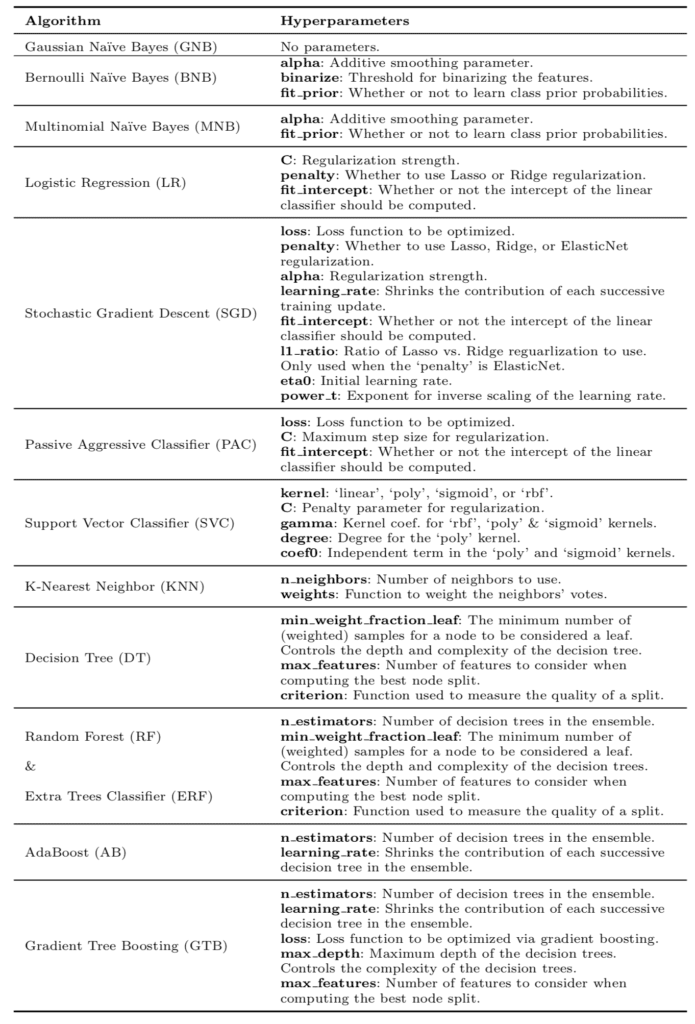
Table of Algorithms and Parameters
Algorithms were evaluated using 10-fold cross-validation and the balanced accuracy measure.
Cross-validation was not repeated, perhaps introducing some statistical noise into the results.
Machine Learning Datasets
A selection of 165 standard machine learning problems were selected for the study.
Many of the problems were drawn from the field of bioinformatics, although not all datasets belong to this field of study.
All prediction problems were classification type problems with two or more classes.
The algorithms were compared on 165 supervised classification datasets from the Penn Machine Learning Benchmark (PMLB). […] PMLB is a collection of publicly available classification problems that have been standardized to the same format and collected in a central location with easy access via Python.
The datasets were drawn from the Penn Machine Learning Benchmark (PMLB) collection, which is a project that provides standard machine learning datasets in a uniform format and made available by a simple Python API. You can learn more about this dataset catalog on the GitHub Project:
All datasets were standardized prior to fitting models.
Prior to evaluating each ML algorithm, we scaled the features of every dataset by subtracting the mean and scaling the features to unit variance.
Other data preparation was not performed, nor feature selection or feature engineering.
Analysis of Results
The large number of experiments performed resulted in a lot of skill scores to analyze.
The analysis of the results was handled well, asking interesting questions and providing findings in the form of easy-to-understand charts.
The entire experimental design consisted of over 5.5 million ML algorithm and parameter evaluations in total, resulting in a rich set of data that is analyzed from several viewpoints…
Algorithm performance was ranked for each dataset, then the average rank of each algorithm was calculated.
This provided a rough and easy to understand idea of which algorithms performed well or not, on average.
The results showed that both Gradient boosting and random forest had the lowest rank (performed best) and that the Naive Bayes approaches had the highest rank (performed worst) on average.
The post-hoc test underlines the impressive performance of Gradient Tree Boosting, which significantly outperforms every algorithm except Random Forest at the p < 0.01 level.
This is demonstrated with a nice chart, taken from the paper.
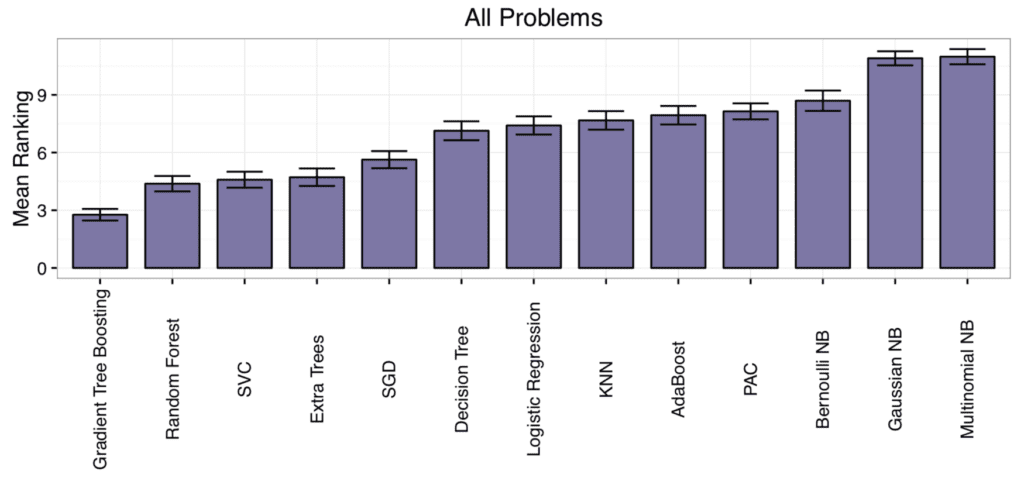
Algorithm Mean Rank
No single algorithm performs best or worst.
This is wisdom known to machine learning practitioners, but difficult to grasp for beginners in the field.
There is no silver bullet and you must test a suite of algorithms on a given dataset to see what works best.
… it is worth noting that no one ML algorithm performs best across all 165 datasets. For example, there are 9 datasets for which Multinomial NB performs as well as or better than Gradient Tree Boosting, despite being the overall worst- and best-ranked algorithms, respectively. Therefore, it is still important to consider different ML algorithms when applying ML to new datasets.
Further, picking the right algorithm is not enough. You must also pick the right configuration of the algorithm for your dataset.
… both selecting the right ML algorithm and tuning its parameters is vitally important for most problems.
The results found that tuning an algorithm lifted skill of a method anywhere from 3% to 50%, depending on the algorithm and the dataset.
The results demonstrate why it is unwise to use default ML algorithm hyperparameters: tuning often improves an algorithm’s accuracy by 3-5%, depending on the algorithm. In some cases, parameter tuning led to CV accuracy improvements of 50%.
This is demonstrated with a chart from the paper that shows the spread of improvement offered by parameter tuning on each algorithm.

Algorithm performance improvement via parameter tuning
Not all algorithms are required.
The results found that five algorithms and specific parameters achieved top 1% in performance across 106 of the 165 tested datasets.
These five algorithms are recommended as a starting point for spot checking algorithms on a given dataset in bioinformatics, but I would suggest also more generally:
- Gradient Boosting
- Random Forest
- Support Vector Classifier
- Extra Trees
- Logistic Regression
The paper provides a table of these algorithms, including the recommend parameter settings and the number of datasets covered, e.g. where the algorithm and configuration achieved top 1% performance.
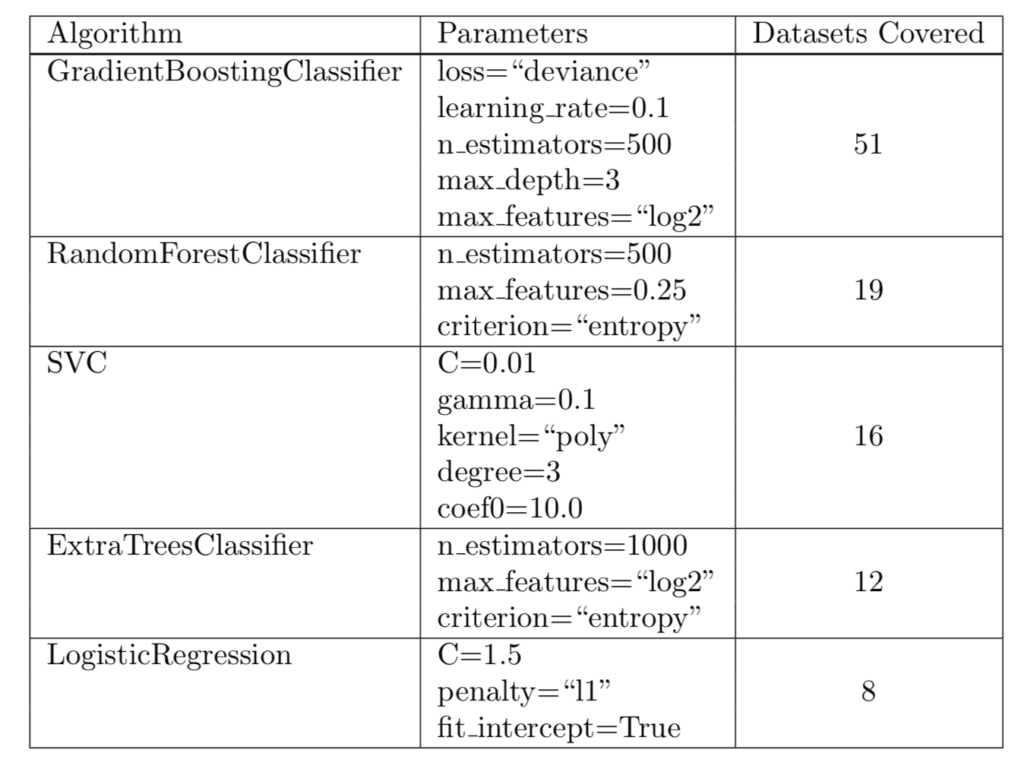
Suggested Algorithms
Practical Findings
There are two big findings from this paper that are valuable for practitioners, especially those starting out or those who are under pressure to get a result on their own predictive modeling problem.
1. Use Ensemble Trees
If in doubt or under time pressure, use ensemble tree algorithms such as gradient boosting and random forest on your dataset.
The analysis demonstrates the strength of state-of-the-art, tree-based ensemble algorithms, while also showing the problem-dependent nature of ML algorithm performance.
2. Spot Check and Tune
No one can look at your problem and tell you what algorithm to use, and there is no silver bullet algorithm.
You must test a suite of algorithms and a suite of parameters for each algorithm to see what works best for your specific problem.
In addition, the analysis shows that selecting the right ML algorithm and thoroughly tuning its parameters can lead to a significant improvement in predictive accuracy on most problems, and is a critical step in every ML application.
I talk about this all the time; for example, see the post:
Further Reading
This section provides more resources on the topic if you are looking to go deeper.
- Data-driven Advice for Applying Machine Learning to Bioinformatics Problems
- scikit-learn benchmarks on GitHub
- Penn Machine Learning Benchmarks
- Quantitative comparison of scikit-learn’s predictive models on a large number of machine learning datasets: A good start
- Use Random Forest: Testing 179 Classifiers on 121 Datasets
Summary
In this post, you discovered a study and findings from evaluating many machine learning algorithms across a large number of machine learning datasets.
Specifically, you learned:
- That ensemble tree algorithms perform well across a wide range of datasets.
- That it is critical to test a suite of algorithms on a problem as there is no silver bullet algorithm.
- That it is critical to test a suite of configurations for a given algorithm as it can result in as much as a 50% improvement on some problems.
Do you have any questions?
Ask your questions in the comments below and I will do my best to answer.






No comments:
Post a Comment