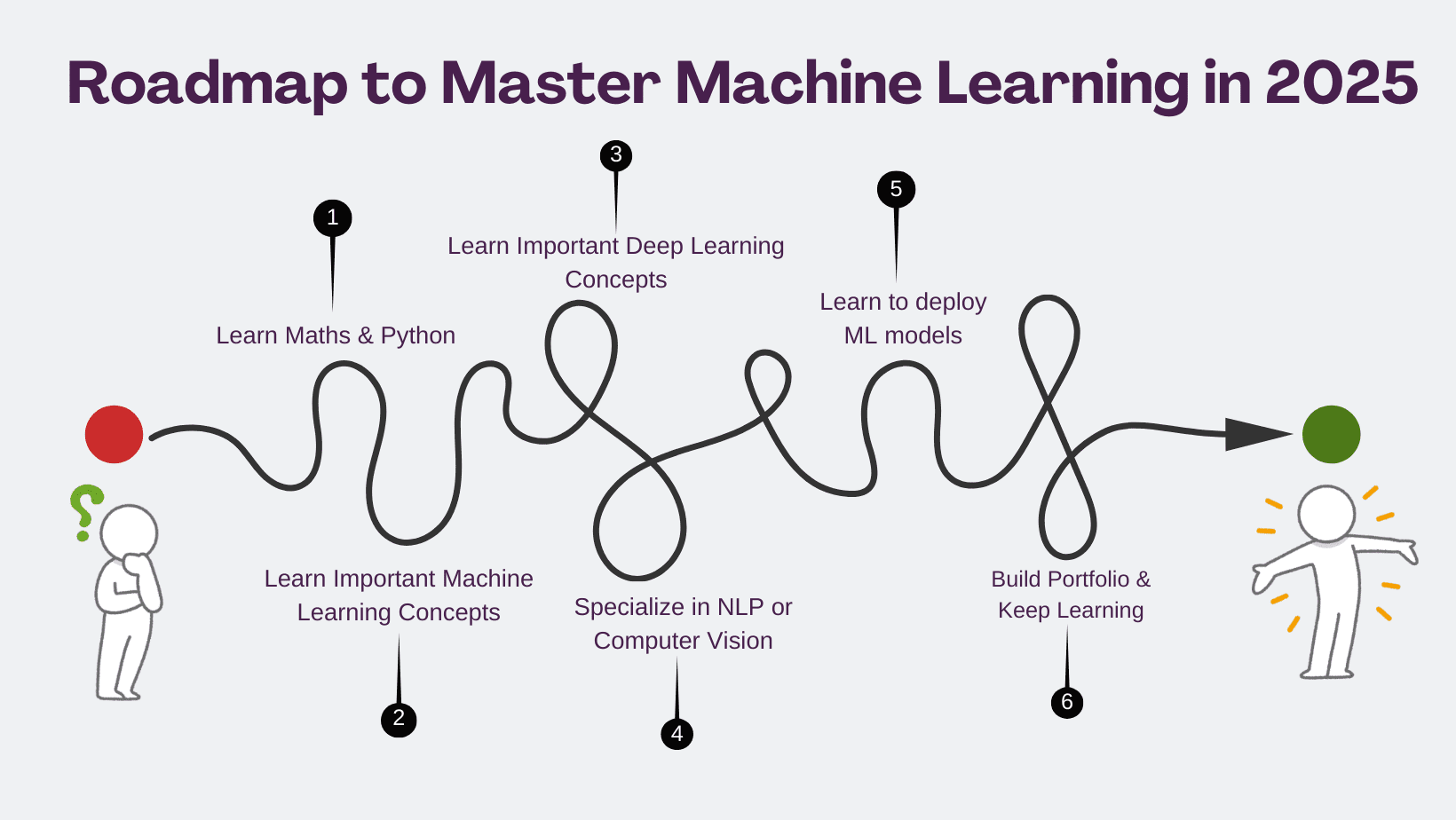
The Roadmap for Mastering Machine Learning in 2025
Image by Author | Canva
Machine learning (ML) is now a part of our daily lives, from the voice assistants on our mobiles to advanced robots performing tasks similar to humans. It has transformed many sectors like healthcare with tools to assist doctors in diagnosing diseases, the automobile industry by introducing self-driving cars, retail by enhancing customer experiences through personalized recommendations, automated inventory management systems, and much more.
The global machine learning market, valued at 14.91 billion in 2021, is projected to grow at a compound annual growth rate (CAGR) of 38.1%, reaching approximately 302.62 billion by 2030, making it a highly sought-after skill to learn by 2025.
Whether you want to understand the basics of ML or build a career in it but are confused about where to start, this guide is here to help you. It provides a clear, step-by-step roadmap to guide you through the essential skills and knowledge needed to master ML in 2025.
What is Machine Learning?
How do you learn to do any task? Obviously, by learning from someone or somewhere and then practicing it repeatedly, which we call gaining experience. This is how human intelligence develops. Similarly, machine learning is the process of supplying information to a machine and letting the machine learn from the data and improve over time.
Machine learning allows computers to perform tasks without explicit instructions for each step. Basically, the system learns to make decisions by recognizing patterns in data. For example, rather than programming a computer to identify a cat, we show it thousands of cat images. The computer learns the key features that define a cat and uses these features to classify the images. Over time, as it processes more data, the computer gets better at identifying cats. Just as humans improve with practice, ML helps computers become smarter and more efficient as they encounter more relevant data.
Now, lets explore how you can start learning ML in 2025.
Step-by-Step Roadmap to Master Machine Learning
Step 1: Prerequisites
First, you need to learn some concepts of mathematics and programming before moving on to machine learning.
Learn Mathematics
- Linear Algebra: Learn vectors, matrices, matrix operations, eigenvalues, and singular value decomposition. You can learn from these YouTube courses:
Machine Learning Foundations: Welcome to the Journey – YouTube
Math for Machine Learning – YouTube
Linear Algebra | Khan Academy - Calculus: Learn derivatives, gradients, and optimization techniques. You can learn it from these video courses:
Calculus for Machine Learning – YouTube
Calculus 1 | Math | Khan Academy
Calculus 1 – Full College Course – YouTube - Probability and Statistics: Focus on key concepts like Bayes’ theorem, probability distributions, and hypothesis testing. You can learn it from these video courses:
Statistics – A Full University Course on Data Science Basics – YouTube
Statistics and Probability Full Course || Statistics For Data Science – YouTube
You can also refer to this amazing book to learn the basics of mathematics needed for Machine learning:
TEXTBOOK: Mathematics_for_Machine_Learning
Learn Programming
- Python (Recommended): Python is the most popular programming language for machine learning. These resources can help you learn Python:
Learn Python – Full Course for Beginners [Tutorial] – YouTube
Python Crash Course For Beginners – YouTube
TEXTBOOK: Learn Python The Hard Way - After clearing the basics of programming, focus on libraries like Pandas, Matplotlib, and Numpy which are used for data manipulations. Some resources that you might want to check out are:
Data Analysis with Python – (Numpy, Pandas, Matplotlib, Seaborn) – YouTube
Numpy, Matplotlib and Pandas by Bernd Klein - R (Alternative): R is useful for statistical modeling and data science. Learn R basics here:
R programming in one hour – a crash course for beginners – YouTube
TEXTBOOK: R for Data Science
Step 2: Understand Key Concepts of Machine Learning
At this step you already have enough knowledge of mathematics and programming, now you can easily start to learn the basics of machine learning. For that purpose, you must know there are three kinds of ML:
- Supervised Learning: Supervised machine learning is a type of machine learning that involves using datasets that are labeled to train algorithms with the aim of identifying patterns and making decisions. Important algorithms to learn: Linear Regression, Logistic Regression, Support Vector Machines (SVM), KNN, and Decision Trees.
- Unsupervised Learning: It is a type of machine learning where the model is trained on unlabeled data to find patterns, groupings, or structures without predefined outputs. Important algorithms to learn: Principal Component Analysis (PCA), k-means clustering, Hierarchical clustering, and DBSCAN.
- Reinforcement Learning: Reinforcement learning is a category of machine learning in which an agent learns to make decisions by interacting with an environment and gets rewarded or punished for its actions. You can skip diving deeper into it at this stage.
The best course I have found to learn the basics of ML is:
Machine Learning Specialization by Andrew Ng | Coursera
It is a paid course that you can buy in case you need a certification, but you can also find the videos on YouTube:
Machine Learning by Professor Andrew Ng
Some other resources you can consult are:
- Machine Learning for Everybody – Full Course – YouTube
- Learn Intro to Machine Learning | Kaggle
- Machine Learning Full Course – Learn Machine Learning 10 Hours | Edureka – YouTube
Try to practice and implement the ML algorithms using the Scikit-learn library of Python. Follow this YouTube playlist for smooth learning.
Step 3: Understand Key Concepts of Deep Learning
After getting a grip on the important concepts of ML, you need to thoroughly understand deep learning.
What is Deep Learning?
It is a type of ML where a computer solves complex tasks using multiple layers of artificial neurons (neural networks). These resources can help you learn deep learning:
- Deep Learning Specialization (DeepLearning.AI) | Coursera (Recommended)
- Deep Learning Crash Course for Beginners – YouTube
After these courses, you will have a good understanding of neural networks including feed forward networks, activation functions, perceptrons, back propagation, Convolutional Neural Networks (CNN) and Recurrent Neural Networks (RNN), model evaluation and optimization, etc.
Focus on the framework that interests you most, PyTorch or TensorFlow. Start by learning one and you can explore the other one later if needed for a project. Some of the resources are:
- PyTorch Tutorials – Complete Beginner Course (Recommended for basics)
- Pytorch Tutorial – Setting up a Deep Learning Environment (Anaconda & PyCharm) (Recommended for detailed covering)
- PyTorch for Deep Learning & Machine Learning – Full Course – YouTube
- Zero to Mastery Deep Learning with TensorFlow
- TensorFlow Tutorial 1 – Installation and Setup Deep Learning Environment (Anaconda and PyCharm ) (Recommended)
- TensorFlow 2.0 Complete Course – Python Neural Networks for Beginners Tutorial
- TensorFlow Developer Professional Certificate – DeepLearning.AI
I am aware that these resources include projects, but let’s be honest we learn the best by practically applying the concepts, so don’t skip the projects. Be sure to try them. After getting the basics of deep it will be easier for you to choose a specialized domain, such as NLP or Computer Vision.
Step 4: Choose a Specialization
Choose a specialized field and then learn advanced concepts within it.
- In Computer Vision, learn about GANs and the implementation of important tasks such as object detection, image segmentation, etc.
- In NLP, study transformers such as BERT and GPT, and some techniques like text classification and sentiment analysis.
Resources:
- Deep Learning – Stanford CS231N
- Generative Adversarial Networks (GANs) Playlist
- Object Detection Series (Deep Learning)
- PyTorch Image Segmentation Tutorial with U-NET: everything from scratch baby
- Introduction – Hugging Face NLP Course
- Intro to NLP with spaCy
- Natural Language Processing Specialization – DeepLearning.AI
- Also please check the following playlist, it contains an implementation of research papers in Pytorch:
Papers Explained (Recommended)
Step 5: Learn to Deploy ML models
After successfully building and training your machine learning model, the next step is deploying it for others to use. The deployment involves making your model available through a web service or application so others can interact with it. Various tools can help you with this, such as Flask and FastAPI for creating REST APIs, Docker for containerizing your application, and cloud platforms like AWS/Azure for scalable deployment. These tools ensure that your model can run smoothly in different environments and handle multiple user requests. Following resources might be useful:
- Deploy ML models with FastAPI, Docker, and Heroku | Tutorial
- How to Deploy ML Solutions with FastAPI, Docker, & AWS
- Deploying Machine Learning Models | Coursera
Step 6: Build a Portfolio and Keep Learning
Build a portfolio showcasing your best projects. Don’t forget to refresh your learning from time to time by building new projects, following key publications, and attending tech meetups. For this purpose:
- You can contribute to GitHub Open Source Projects
- Get up-to-date research papers at Papers with Code and arXiv
Wrapping Up
This guide provides a clear roadmap to learning and mastering ML by 2025. If you’re eager to learn, just remember: the most important step is to begin. Take it one step at a time, and you’ll make steady progress. If you have any questions or need extra help along the way, feel free to leave a comment — I’m here to assist you on your journey!








No comments:
Post a Comment